|
37° Stormo
|
 |
L’F 16 Fighting Falcon è un aereo da combattimento sviluppato dalla General Dynamics, ora assorbita dalla Lockheed Martin, il progetto originale prevedeva che fosse costruito come caccia leggero, successivamente venne pensato come velivolo multiruolo. La sua versatilità lo ha fatto diventare a pieno titolo il più grande progetto aeronautico occidentale della storia sino ad oggi. I numeri parlano chiaro, più di 4.400 velivoli prodotti e venduti in 25 differenti nazioni, talmente efficiente ed efficace che ha distanza di 33 anni dall’inizio della sua produzione nel 1976 viene continuamente aggiornato e sviluppato riscontrando ancora un successo di mercato a livello planetario.
Il programma ha origine a metà degli anni sessanta, prima con uno sviluppo denominato ADF (Advanced Day Fighter), velivolo leggero con peso di 11.300 kg che doveva surclassare le performance dell’allora temutissimo Mig 21 Fishbed di costruzione sovietica, progetto che viene però abbandonato con l’avvento del possente Mig 25 Foxbat. Con la fine degli anni sessanta invece i progetti per un nuovo caccia di media dimensioni tornano di attualità, i primi fondi, anche se limitati, vengono suddivisi tra General Dynamics e Northrop, fondi che vengono dedicati dalle due note case costruttrici ad un progetto per un aereo da combattimento, piccolo, leggero, a basso drag e senza bombe, le sigle dei due caccia furono: YF 16 per General Dynamics e YF 17 per Northrop.
Nonostante l’ostilità dei fautori di un altro progetto in pieno sviluppo chiamato FX (base del futuro F 15 Eagle), per un caccia di dimensioni superiori, il programma ADF, a sua volta ridenominato F-XX, guadagna il supporto dell’allora Segretario della Difesa David Packard.
Nel maggio del 1971 si materializzano le prime sei proposte, di queste solo due vengono accettate, tra le due ritenute valide compare quella denominata Lightweight Fighter (LWF – caccia leggero). A questo punto vengono emanante le RFP (Reguest For Proposal) che vengono inviate alle case costruttrici di settore nel gennaio dell’anno successivo.
Cinque compagnie risposero alle richiesta e nel marzo del 1972 vennero annunciati i vincitori per sviluppare un prototipo, le vincitrici furono Boeing con il modello 908-909 e General Dynamics con il modello 401; purtroppo per Boeing però arriva il declassamento a favore di Northrop, solo in un secondo tempo il suo un progetto denominato P 600 viene ritenuto più rispondente rispetto a quello di Boeing; definiti i requisiti finali le due case costruttrici formalizzano i contratti per produrre dei prototipi con i primi voli pianificati all’inizio del 1974. |
 |
 |
|
Caratteristiche tecniche
Dimensioni
Lunghezza 14,52 mt
Altezza 5,01 mt
Apertura alare 9,45 mt
Superficie alare 27,87 mq
Pesi
Peso a vuoto 7.710 kg
Peso massimo al decollo 15.890 kg
Capacità carburante interna 3.200 kg
Capacità carburante esterna 3.066 kg
Prestazioni
Velocità massima 2 mach a 12.000 mt
Tangenza max 15.000 mt
Autonomia 3.900 km
G-limit + 9 G - 3,5 G
Impianto propulsivo
Turbofan Pratt & Whitney F100-PW-200 da 12.150 kg di spinta con postcombustione
Armamento
Cannone a sei canne rotanti General Electric M 61 Vulcan con 511 colpi
Due - quattro missili AIM 9M/P Sidewinder
Due AIM 7 Sparrow
Avionica
Radio HF Bendix King ARC 200 HF/SSB
Sistema AIFF Teledyne E-Systems Mk XII
Radar AN/APG-66(V)1
Radio UHF/VHF
Ricevitore di allarme Radar ALR
Radar altimetro
Equipaggio ed abitacolo
Un pilota versione ADF, un pilota + allievo versione B
Schermo HUD (Head Up Display)
Seggiolino eiettabile ACCESS II
Display mulifunzione
Sistema HOTAS (Hands on Throttle and Stick)
Comandi Fly by Wire
|
Technical characteristics:
Dimensions
Length 14.52 m
Height 5.01 m
Wing span 9.45 m
Wing area 27.87 m2
Weights
Empty weight 7,710 kg
Maximum take-off weight 15,890 kg
Internal fuel capacity 3,200 kg
External fuel capacity 3,066 kg
Performance:
Maximum speed Mach 2 at 12,000 m
Ceiling 15,000 m
Range 3,900 km
G-limits + 9 G – 3.5 G
Powerplant
Pratt & Whitney F100-PW-200 turbofan producing 12,150 kg thrust with afterburner
Armament
Six barrel rotating General Electric M 61 Vulcan cannon with 511 rounds
Two - four AIM 9M/P Sidewinder missiles
Two AIM 7 Sparrow missiles
Avionics
Bendix King ARC 200 HF/SSB HF Radio
Teledyne E-Systems Mk XII AIFF system
AN/APG-66(V)1 Radar
UHF/VHF Radios
Radar ALR receiver alarm
Radar altimeter
Crew and cockpit
ADF version – one pilot: B version, instructor pilot and student
HUD screen (Head Up Display)
ACCESS II ejector seat
Multifunction Display
HOTAS system (Hands on Throttle and Stick)
Fly by Wire controls
|
|
|
|
Il primo volo dell’YF 16 venne fatto il 2 febbraio del 1974 presso l’Air Force Flight Test Center sulla base di Edwards in California, il volo ebbe una durata di ben 90 minuti, il primo volo supersonico venne invece compiuto tre giorni dopo, il secondo prototipo invece staccò le ruote da terra il 9 maggio, mentre il diretto rivale YF 17 iniziò i voli con qualche settimana di ritardo. Il YF 16 ha effettuato un totale di 330 voli e 417 ore di volo.
A questo punto il progetto LWF diventa un probabile, ma non certo, progetto di acquisizione da parte dell’Aeronautica Statunitense, fattore che potrebbe ancora danneggiare pesantemente il programma. Nel frattempo anche per altri membri della NATO (Belgio, Danimarca, Olanda e Norvegia) si prospetta la necessita di sostituire l’ormai vetusto F 104G Starfighter con un nuovo caccia, inoltre bisogna tenere conto che forte è la volontà di queste nazioni di mantenere la possibilità di costruire il velivolo su licenza come si era fatto appunto fatto per il “Cacciatore di Stelle”. Nel 1974 viene raggiunto un importante compromesso per mantenere in vita il progetto, i quattro paesi spingono sempre di più gli Stati Uniti ad accordarsi per l’inizio della costruzione in serie del nuovo caccia ponendo però come clausola primaria che anche l'aeronautica statunitense avesse ordinato l'aereo vincitore della competizione LWF, garantendo così l'acquisto di qualche centinaio di esemplari, nonostante l’USAF non fosse particolarmente interessata in un aereo da combattimento complementare. Un altro passo fondamentale che fecero le quattro nazioni è stato quello di costituire il "Multinational Fighter Program Group" continuando a fare notevoli pressioni sugli Stati Uniti per dare una accelerata alla decisione prevista per il maggio del 1975, anticipata però al dicembre dell’anno precedente proprio grazie ha queste pressioni e che diedero anche un accelerazione alla fase di test, un altro passo che diede un forte aiuto all’LWF, fu un apposito piano predisposto dal Congresso americano che stava cercando di raggiungere una maggiore convergenza negli approvvigionamenti dell'aeronautica e della marina, sgombrando così anche il campo dalla diatriba che ha accompagnato per tutto il percorso il progetto LWF contrapponendolo al progetto FX, ora non più come competitore ma come complemento.
Finalmente l’11 settembre 1974 l’aeronautica statunitense conferma i piani di acquisizione per un numero di velivoli in grado di equipaggiare cinque TFW (Tactical Fighter Wings), il successivo 13 gennaio del 1975 il segretario dell’Aeronautica annuncia la vincita del YF 16. I vantaggi principali che hanno permesso al futuro Fighting Falcon sono i costi operativi inferiori e le migliori performance rispetto al YF 17, un fattore primario che diede un valore aggiunto al programma venne anche dato dalla scelta del propulsore, il Pratt & Whitney F 100, lo stesso che avrebbe montato l’F 15, riducendo notevolmente i costi.
La fase di sviluppo viene inizialmente decisa per 15 aerei, successivamente poi ridotti a otto, come “Full-Scale Development” per i programmi di test, mentre la produzione inizia nel tardo 1975 a Forth Worth in Texas presso lo stabilimento della General Dynamics, il primo esemplare di serie, un F 16A, ha effettuato il primo volo l’8 dicembre del 1976, mentre il primo biposto (F 16B) compie il primo volo l’8 agosto dell’anno successivo. La prima serie di produzione dell’F 16A ha volato nel 1978 con consegne a partire dall’anno successivo, il servizio operativo inizia il primo ottobre del 1980 presso il 388° Tactical Fighter Wing sulla base di Hill. |
 |
 |
Per quanto riguarda le future esportazioni l’aereo venne offerto anche ai paesi alleati della NATO, mentre la prima presentazione all’estero avviene durante la manifestazione aerea di Parigi del 1975. Come da accordi il consorzio MFPG mantiene l’impegno preso in sede di sviluppo firmando un contratto per l’acquisto di 348 esemplari, ottenendo anche la condizione che tutti velivoli venissero assemblati in Belgio, nell’importante contratto è stato anche incluso che alcune parti del velivolo venissero costruite nelle industrie del vecchio continente, le consegne sarebbero state eseguite a partire dal 1979. Le versioni basi A e B vengono sostituite nei primi anni 80 dalle evoluzioni C e D che presentavano delle migliorie sia nel comparto motorizzazione che in quello dell’avionica, ulteriori e continui aggiornamenti si sono susseguite negli anni ed erano rappresentate con una numerazione crescente del “Block” di appartenenza.
Nel 1993 la General Dynamics cessa le attività e il progetto ormai al top dell’evoluzione viene ceduta alla Lockheed Martin, sotto questo nuovo marchio vengono prodotte le nuove versioni E, F e I che però riscuotono successo solo sul mercato di esportazione.
L'F 16A è un aereo tattico multiruolo supersonico a singolo propulsore, progettato per essere un velivolo relativamente economico da impiegare per molti tipi di missione e mantenere la prontezza di intervento. È più piccolo e leggero dei suoi predecessori, ma impiega soluzioni aerodinamiche e sistemi avionici avanzati, tra le altre cose è stato il primo velivolo da combattimento ad impiegare il sistema fly-by-wire, grazie al quale ha potuto aumentare notevolmente le proprie performance. Molto agile, l'F 16A può raggiungere fattori di carico fino a + 9 G positivi e -3,5 G negativi, e una velocità massima superiore a Mach 2.
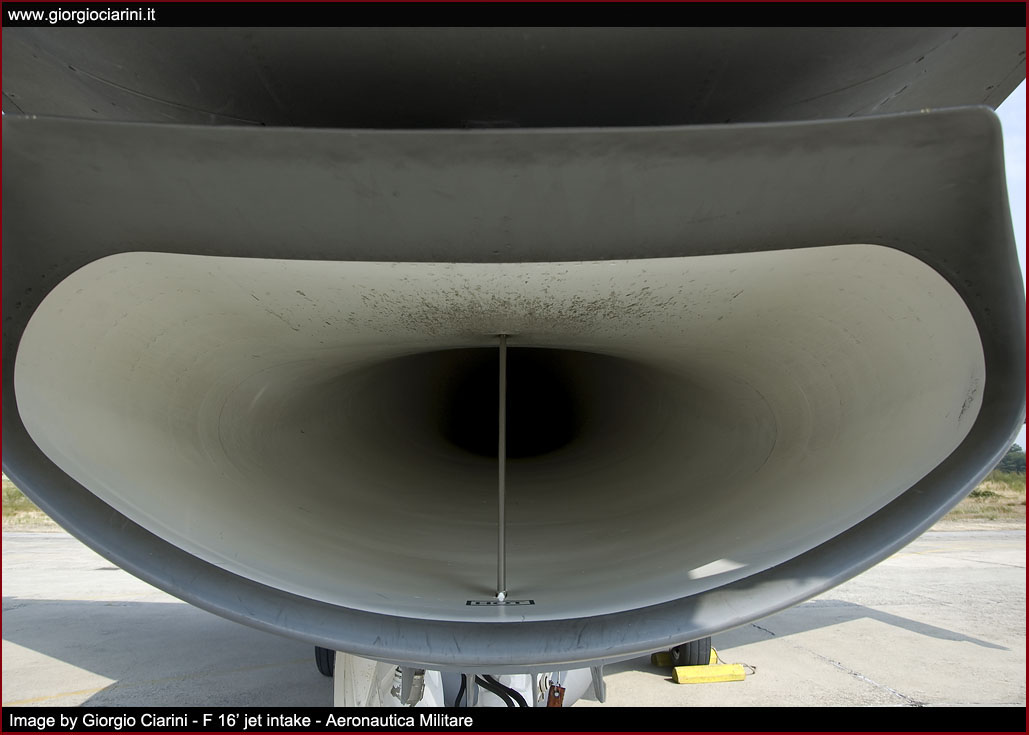
La cellula dell’F 16 ha una struttura abbastanza semplice e tradizionale, e molto leggera. La presa d'aria è semplice e senza sistema di variazioni dell'entrata, mentre le ali sono a delta con un bordo di attacco molto allungato, queste estensioni chiamate LEF servono per incrementare la maneggevolezza, mentre sul bordo esterno delle ali sono montate le rotaie per il montaggio di missili aria-aria.
La deriva è singola, non di grandi dimensioni ma supportata da due pinne ventrali posteriori di notevoli impatto come superficie, non usuali nei velivoli di produzione occidentale ma invece classiche nei velivoli sovietici.
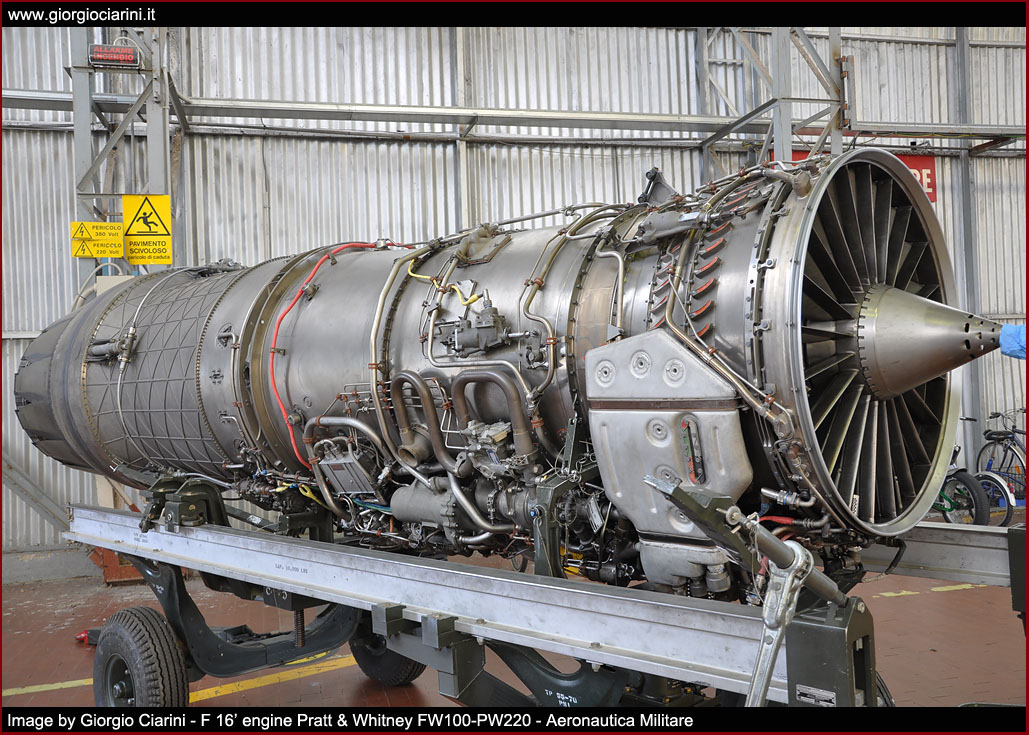
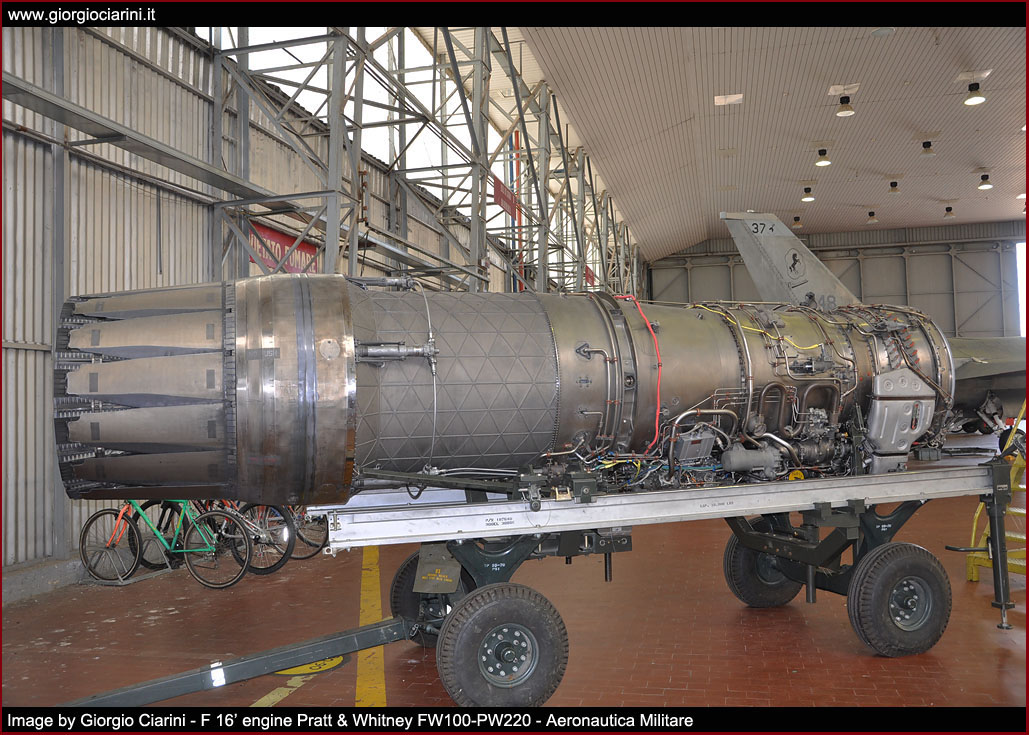
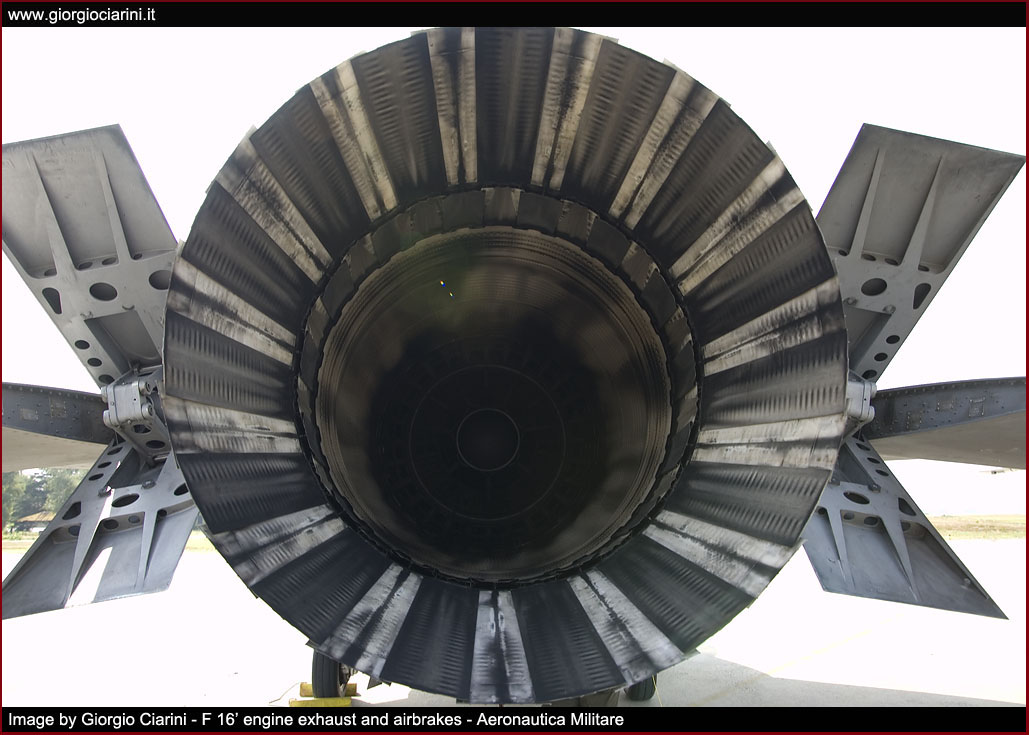
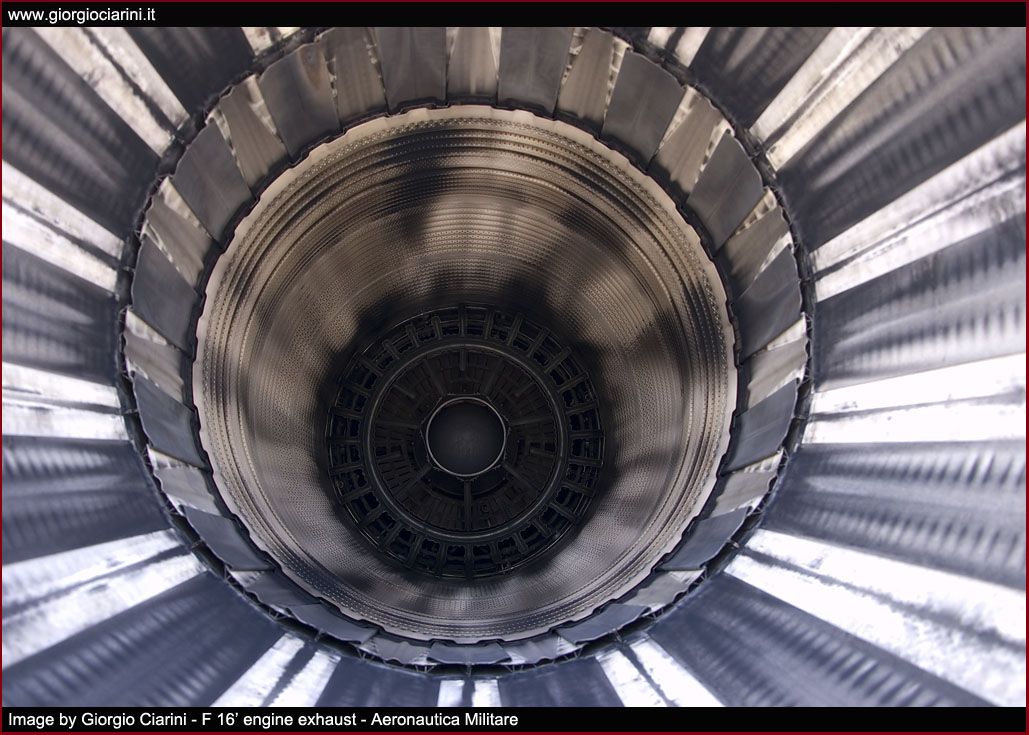
La motorizzazione del “16” iniziale consisteva nella turboventola Pratt & Whitney F100-PW200, versione leggermente modificata del modello F100- PW100 impiegato invece sull’F 15, questa versione utilizzata sul modello A e B sino al Block 25 ha una spinta di 106 KN. Sugli esemplari della serie Block 15 che hanno fatto parte dell’aggiornamento “Operational Capability Update” hanno introdotto l’F100-PW220 con una spinta simile alla versione precedente. Quest’ultima versione è stata utilizzata anche nella serie Block 32 e 42 ed era dotata di un componente chiamato DEEC (Digital Electronic Engine Control), con il compito di controllare il propulsore aumentandone l’affidabilità.
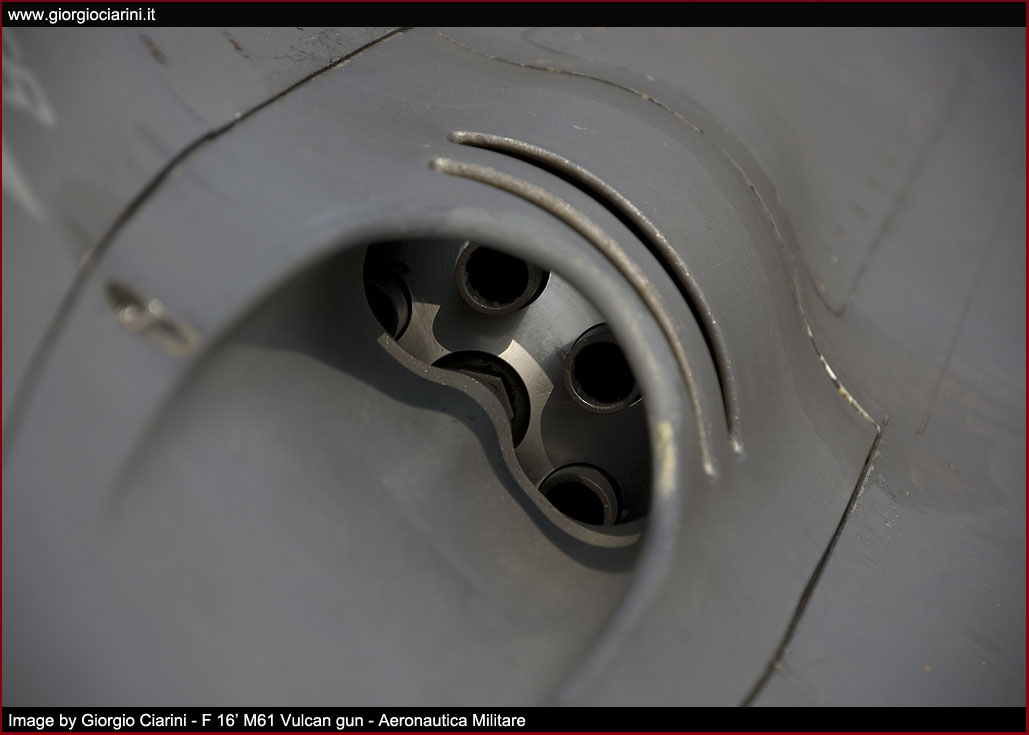
Per quanto riguarda gli armamenti il Falcon è equipaggiato con un cannone da 20 mm M 61 Vulcan, situato al di sopra della radice alare sinistra, i primi modelli potevano caricare fino a sei missili aria-aria a ricerca di calore AIM 9 Sidewinder, agganciati ai vari piloni sub alari, mentre alcune varianti possono impiegare i missili aria-aria a guida radar AIM 7 Sparrow, oppure nelle versioni recenti questi sono equipaggiati anche con gli AIM 120 AMRAAM. Nei dieci agganci subalari o in quello sotto fusoliera possono esser caricati altri tipi di missile aria-aria, un'ampia varietà di missili aria-terra, razzi o bombe, contromisure elettroniche, POD di navigazione, di identificazione del bersaglio o POD di armamento.
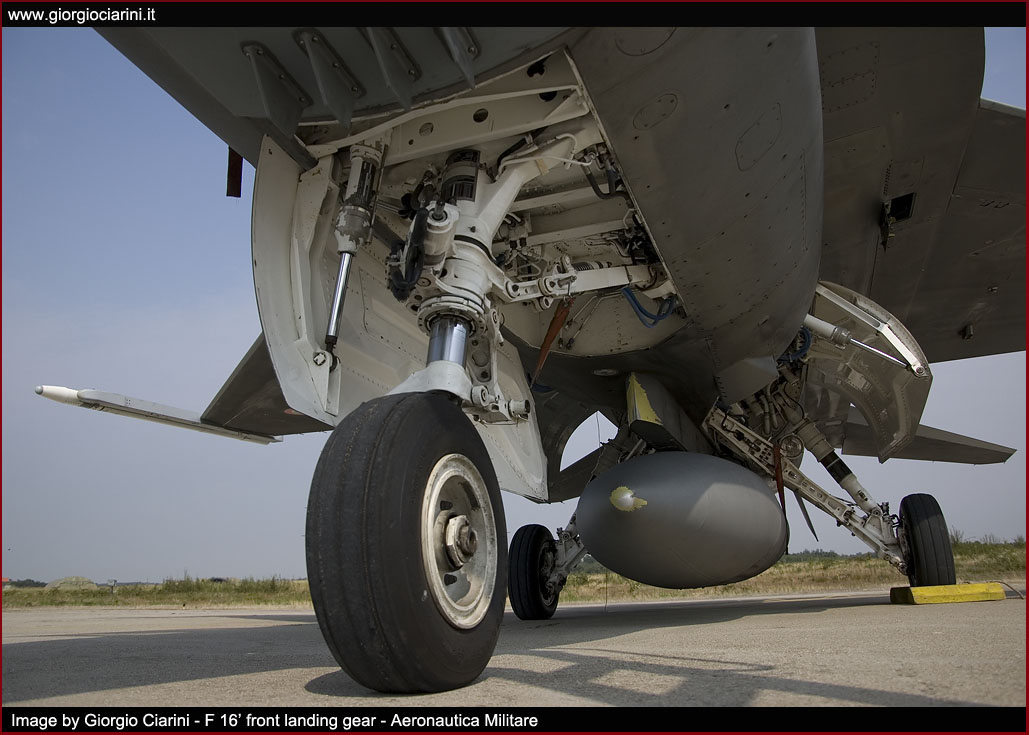
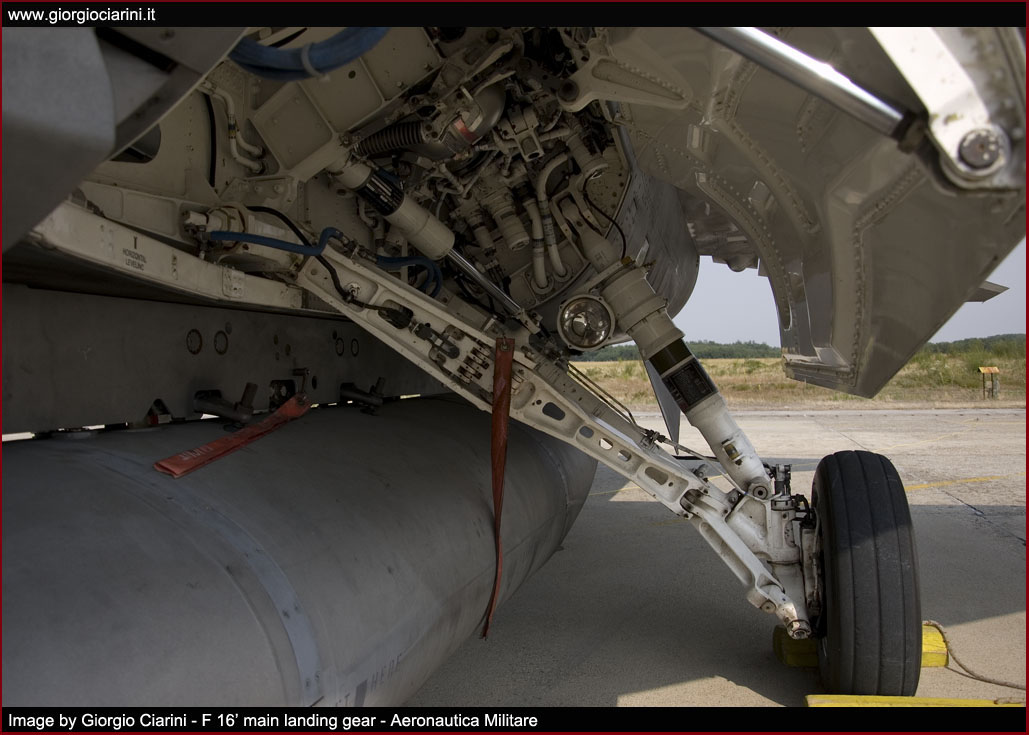
L'F 16 è stato progettato per essere meno costoso e con una manutenzione molto più semplice rispetto ai suoi predecessori. La fusoliera è costituita per l'80% con una lega di alluminio aeronautico, l'8% di acciaio, 3% di materiali compositi e l'1,5% di titanio. Le superfici di controllo di volo, come i flap, gli alettoni e le pinne ventrali sono costruite impiegando elementi con struttura a nido d'ape in alluminio e finitura di resina epossidica rinforzata con grafite. L'F 16 possiede 228 pannelli di accesso, sparsi su tutto l'aereo, l'80% dei quali può essere raggiunto dai tecnici senza cavalletti. Il numero di punti di lubrificazione, di connettori delle linee di alimentazione e dei moduli sostituibili è stato notevolmente ridotto rispetto ai velivoli di progettazione antecedente.
Inoltre fu il primo aereo intenzionalmente progettato per essere leggermente instabile aerodinamicamente. Questa tecnica, chiamata stabilità statica rilassata, fu impiegata per migliorare ulteriormente le performance di manovra dell'aereo. La maggior parte degli aerei è progettata con stabilità statica positiva, che fa recuperare l'assetto precedente del velivolo a seguito di una variazione. Tuttavia, la stabilità positiva ostacola la manovrabilità, poiché la tendenza a mantenere l'assetto si oppone agli sforzi del pilota che invece lo vuole modificare; d'altro lato, un aereo con stabilità negativa, in assenza di controlli, si allontanerà velocemente da un volo controllato e livellato. Per questo motivo, un aereo con stabilità negativa sarà maggiormente manovrabile. A velocità supersonica, un tale aereo possiede una stabilità maggiore a causa delle forze aerodinamiche, mentre a velocità subsonica, l'aereo è sempre sull'orlo di perdere il controllo.
Per controllare la tendenza dell'aereo ad allontanarsi da un assetto stabile, ed evitare al pilota la necessità di controbilanciare costantemente con i controlli, l'F 16A possiede un sistema fly-by-wire a quattro canali. Il computer per il controllo di volo, la componente chiave del sistema, rileva i comandi del pilota dalla cloche e del timone e comanda le superfici di controllo di volo per produrre la manovra desiderata dal pilota senza perdere il controllo del velivolo. Il computer effettua ogni secondo migliaia di rilevazioni dell'assetto ed effettua correzioni automatiche per controbilanciare le deviazioni dal percorso di volo che non sono state inviate dal pilota, permettendo un volo stabile.
Il computer incorpora una serie di limitatori che governano i movimenti nei tre assi principali, in base all'assetto dell'aereo, alla velocità e all'angolo di attacco, impedendo i movimenti delle superfici di controllo che potrebbero generare delle instabilità come una "slittata" o una "scivolata", oppure aumentare eccessivamente l'angolo di attacco fino a entrare in stallo. I limitatori inoltre impediscono di raggiungere accelerazioni superiori al limite.
Mentre nelle varianti A e B il sistema era affidato a componenti elettroniche di tipo analogico, a partire dai modelli F 16C/D Block 40 questo sistema è stato sostituito da un sistema digitale.
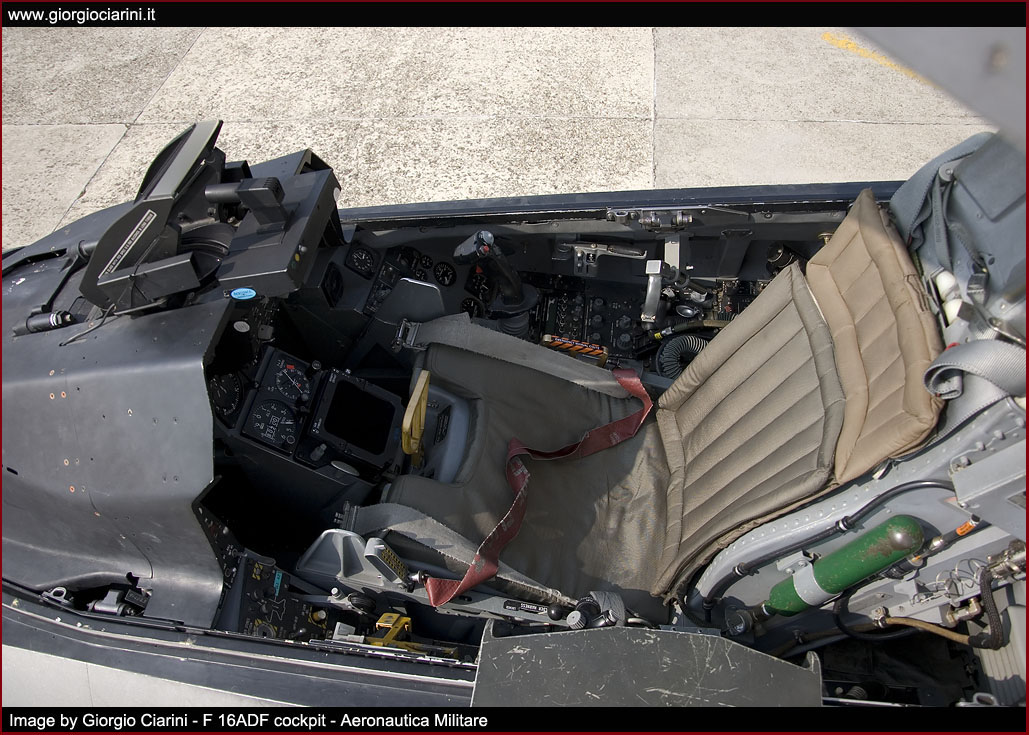
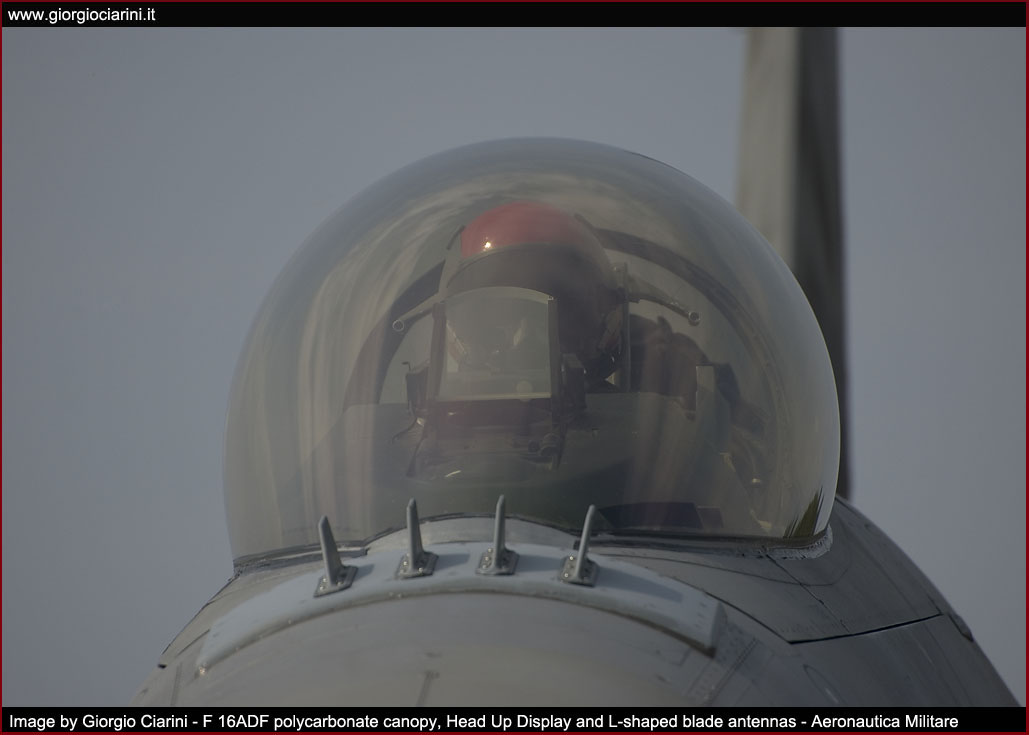
Dalla prospettiva del pilota, una delle caratteristiche più evidenti dell'F 16 è l'eccezionale visuale dall'abitacolo, caratteristica vitale durante il combattimento aria-aria. Il tettuccio in policarbonato a prova di impatto con volatili, fornisce una visuale a 360°, con 40° gradi verso il basso dai lati e 15° verso il basso dal muso (paragonato ai 12-13° dei predecessori); il sedile del pilota è montato in posizione più elevata. Inoltre, il tettuccio è costruito come un pezzo singolo, senza giunture o connessioni tra le parti che ostruiscono la visuale del pilota. Solo nelle versioni a due posti è presente un elemento di rinforzo che crea una interruzione, a causa della lunghezza del tettuccio.
Il pilota guida l'aereo principalmente attraverso un joystick montato sul poggia braccio di destra (invece della comune posizione centrale), e una manetta per i propulsori nella parte sinistra. Sono presenti convenzionali pedali per il timone. Per migliorare il controllo del pilota in manovra ad alti g, molti controlli sono stati raggruppati e resi accessibili sui due gruppi di controllo posizionati su entrambi i lati, questo sistema si chiama HOTAS (Hands on Throttle and Stick). Una leggera pressione della mano sul controllo provoca la trasmissione dei segnali elettrici attraverso il sistema fly-by-wire alle varie superfici di controllo. Inizialmente il joystick era fisso, ma questa soluzione si rivelò scomoda e difficile da gestire per i piloti, quindi venne inserito una certa quantità di "gioco" sulla manopola. Dalla loro introduzione sull'F 16, i controlli HOTAS sono diventati standard nei moderni aerei da combattimento, l'abitacolo possiede un display a testa alta (Head up display - HUD), che proietta le informazioni di volo e di combattimento attraverso icone e simboli di fronte al pilota, senza ostruirne la visuale. Potendo tenere la testa sopra alla linea dell'abitacolo, questo sistema migliora la conoscenza da parte del pilota di quello che sta succedendo intorno a lui.
Un’altra evoluzione che permette al pilota un migliore controllo della situazione avviene grazie ai display multifunzione. Il display di sinistra è quello primario e mostra generalmente mappe e rilevazioni radar, quello di destra è il display di sistema, che mostra le informazioni fondamentali sul propulsore, sul carrello di atterraggio, sulle impostazioni dei flap e degli slat, la quantità di carburante e lo stato delle armi.
Un’altra peculiarità del Fighting Falcon è il sedile ACES II, seggiolino eiettabile reclinato con un angolo di 30° per migliorare la tolleranza dei piloti ad alte forze di accelerazione, diminuendo la probabilità di perdere conoscenza. Questa configurazione deve essere tuttavia associata all'uso di un appoggiatesta, per evitare dolori al collo. Successivamente, i progettisti degli aerei furono diminuiti ad un angolo di 20°.
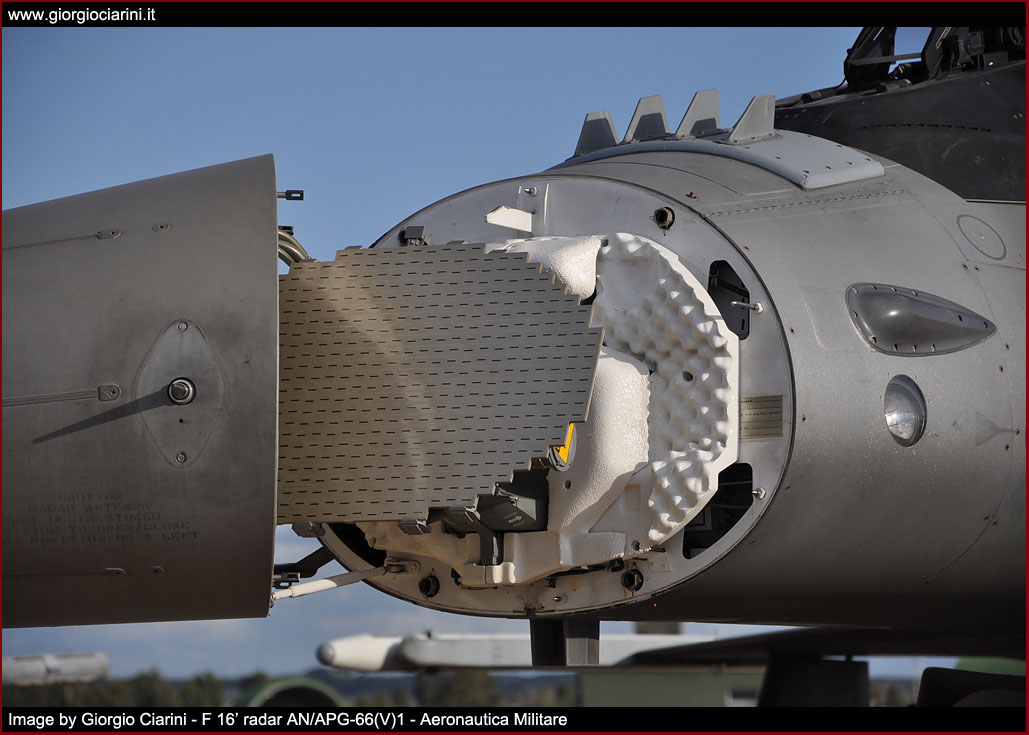
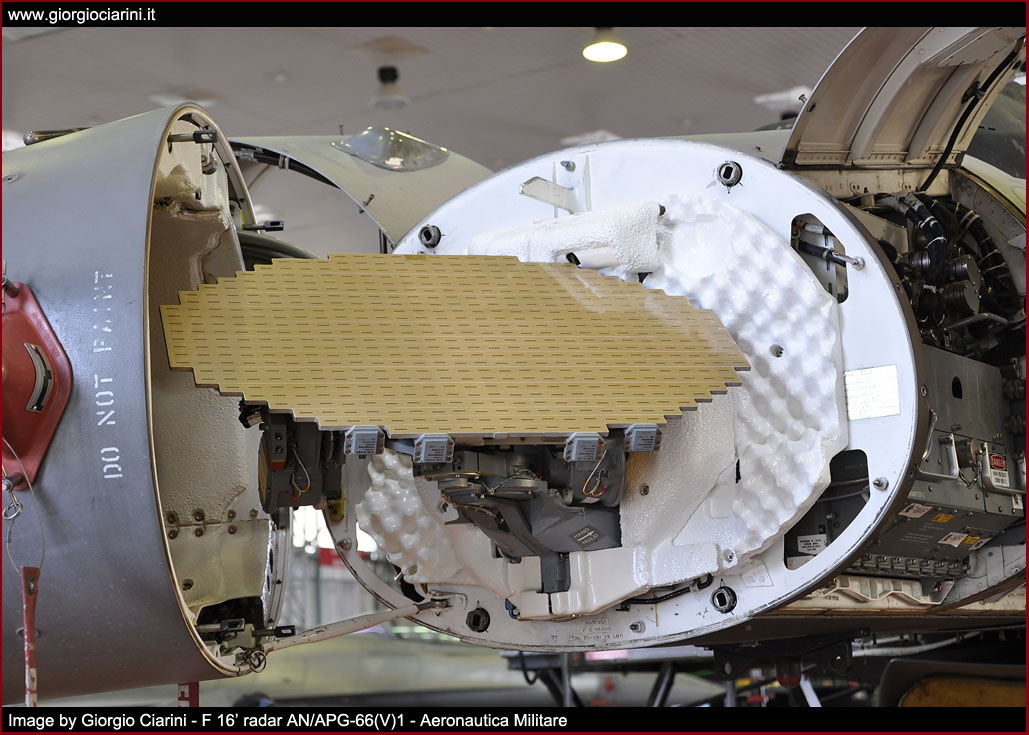
Per quanto riguarda la dotazione radar dell’F 16, le versioni originali A e B erano dotate dell’AN/APG-66 di produzione Westinghouse (ora Northrop Grumman). L'antenna ad Array è sufficientemente compatta da essere contenuta nel relativo piccolo radome dell'aereo. Possedeva quattro frequenze operative all'interno della banda X (8-12 GHZ), e forniva quattro modalità di combattimento aria-aria e sette modalità aria-terra, anche di notte o con maltempo. |
 |
La versione successiva montata a partire dai Block 15 è l'AN/APG-66(V)2, radar dotato di un nuovo e più potente processore, una migliore affidabilità e un range maggiore in ambienti disturbati o in presenza di contromisure radar. Un’altra versione aggiornata è l’AN/APG-66(V)2A con un ulteriore aumento di velocità e di memoria.
Sempre rimanendo nel contesto dell’avionica, la dotazione del caccia comprende di un ricevitore di allarme radar della serie ALR, radar altimetro, radio UHF/VHF, IFF, inoltre è predisposto per montare i Pod ECM quali l’ALQ 119, l’ALQ 131 e l’ALQ 184, come difesa attiva il velivolo ha montato dei lanciatori di inganni radar “Decoy” posti all’esterno della fusoliera posteriore.
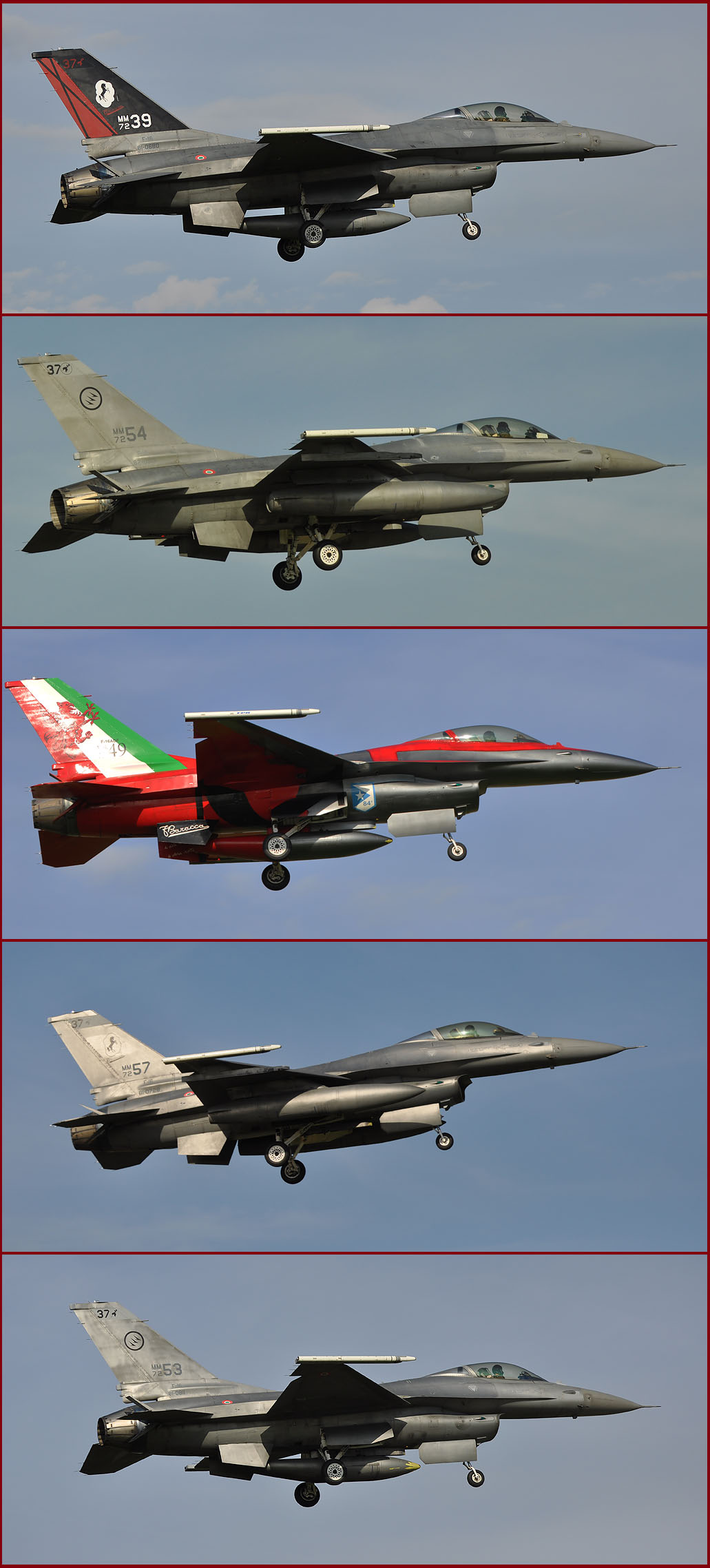
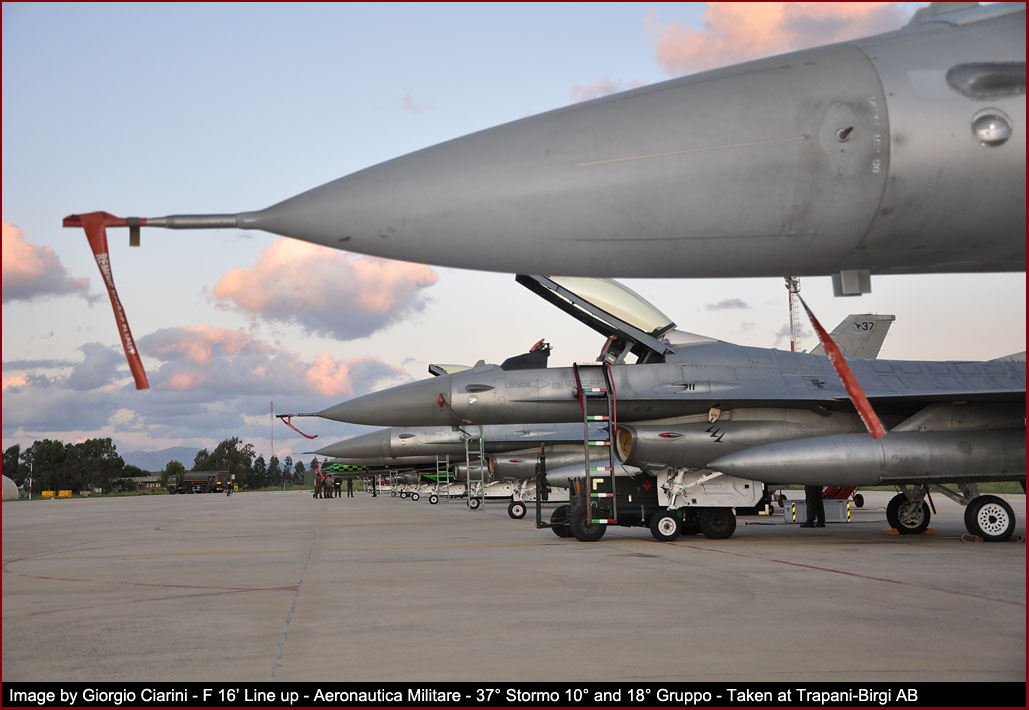
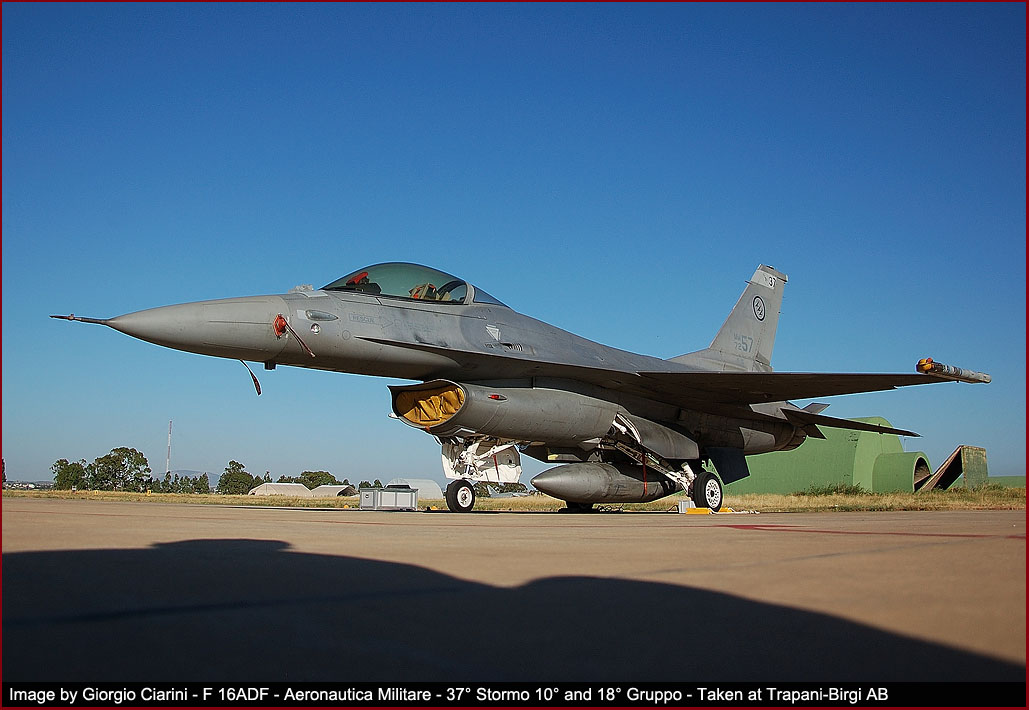
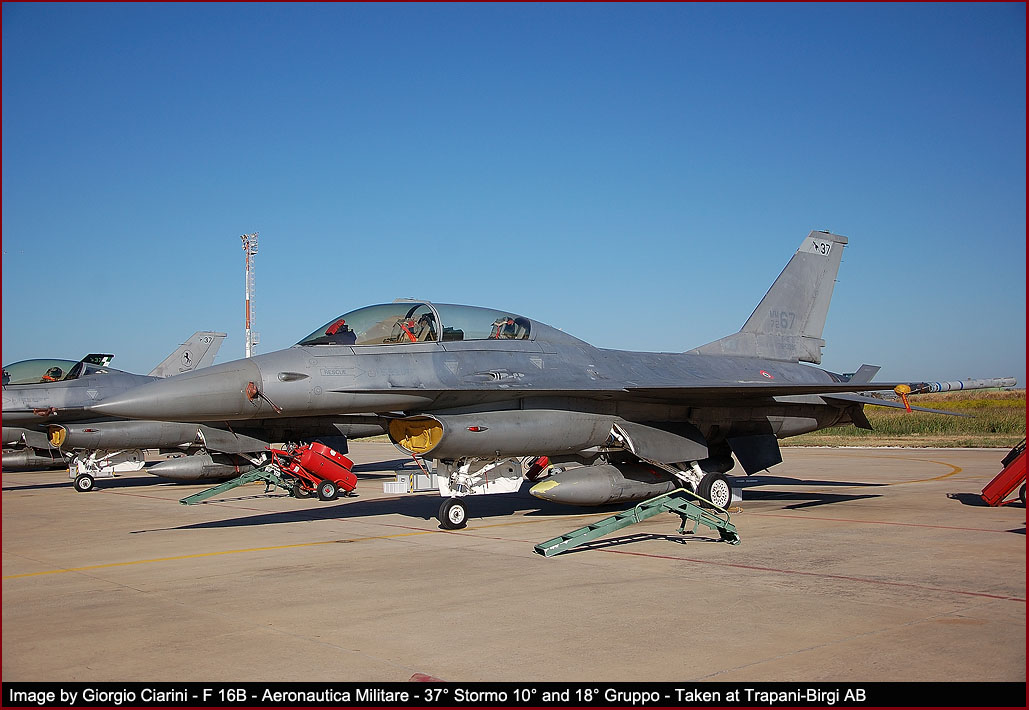
La versione che è stata acquisita tramite leasing dalla nostra Forza Aerea è quella denominata ADF (Air Defence Fighter), a partire dal 2003 l’Aeronautica Militare ha ricevuto 34 velivoli, 30 nella versione monoposto e quattro nella versione biposto, i quali sono andati ad equipaggiare tre Gruppi di Volo, il 23° Gruppo del 5° Stormo di Cervia, il 10° e il 18° Gruppo del 37° Stormo di Trapani Birgi.
I velivoli in servizio presso le Basi di Trapani e Cervia sono nello standard “Block 15 Falcon Up” per la versione monoposto e Block 10 per quelli da conversione operativa biposto, tutti provengono dalle file dell’ANG.
La versione ADF è stata voluta dall’USAF per equipaggiare i reparti della Difesa Aerea nel settore nord in seno all’Air National Guard, nel 1986 oltre 270 esemplari di F 16A e B della serie Block 15 e 10 furono aggiornati e modificati con un’avionica ottimizzata per questo specifico ruolo ed inoltre sono stati resi compatibili per trasportare il missile a guida radar semiattiva AIM 7 Sparrow, la modifica venne effettuata presso l’Ogden Air Logistics Center in Utah.
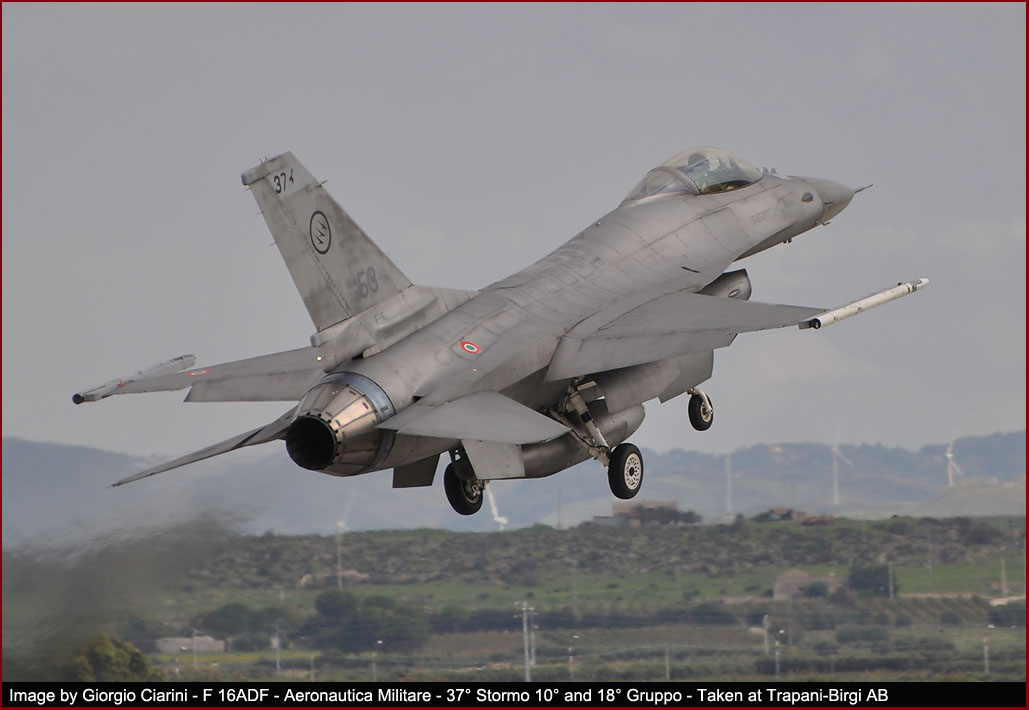
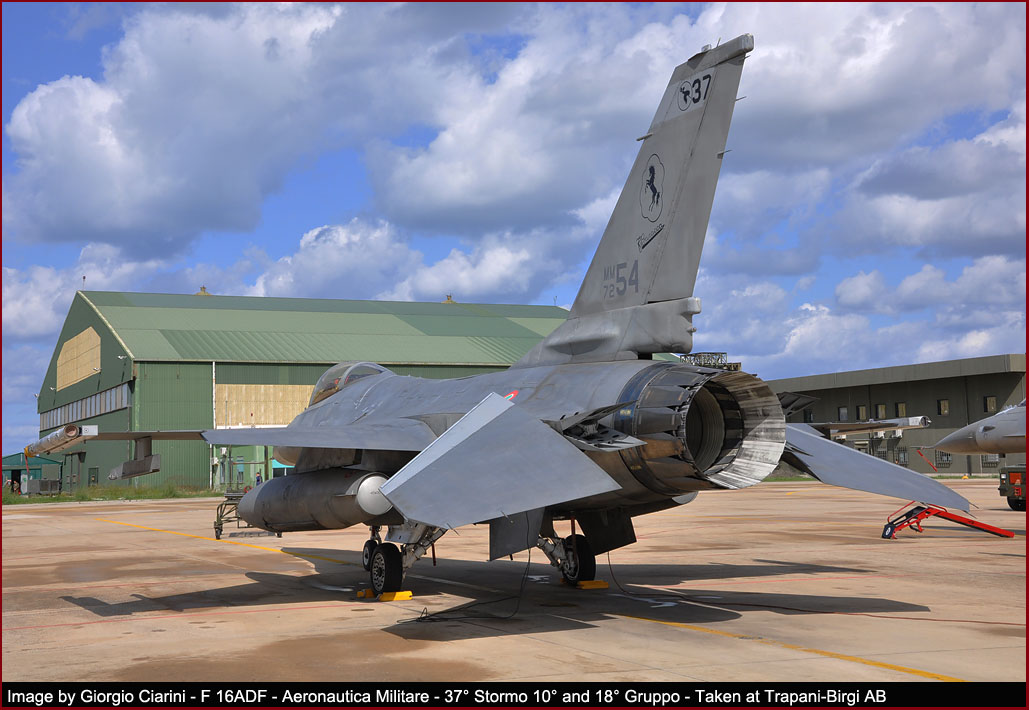
Le modifiche che caratterizzano la versione ADF rispetto alla versione originale sono abbastanza evidenti, partendo dalle antenne posizionate sulla parte superiore appena davanti al tettuccio e nella parte inferiore sotto la presa d’aria, queste antenne chiamate “bird-slicer” sono parte del sistema di identificazione avanzata AIFF (Advanced Identification Friend or Foe) AN/APX-109 MkXII della Teledyne/E-System. L’altra modifica che evidenzia la versione ADF sono i due “bulbi” che sporgono sulla base della deriva su entrambi i lati, questa modifica si è resa necessaria per installare l’antenna radio HF (High Frequency) a singola banda AN/ARC-200HF/SSB della Bendix King, in verità la protuberanza è stata creata per alloggiare due attuatori del timone direzionale, che sono stati spostati per far posto all’antenna, queste caratteristiche sono peculiari della versione monoposto ADF, mentre sulla versione B ADF monta solo il sistema di identificazione ma non l’antenna HF.
Inoltre l’ADF monta il Radar Westinghouse AN/APG-66(V)1, con capacità “Look-down/shoot-down” versione implementata che ha come caratteristica la capacità di illuminare un bersaglio per dirigere il missile a guida semi attiva AIM-7 Sparrow. |
|
English translation
The F 16 Fighting Falcon is a combat aircraft developed by General Dynamics, which has now been absorbed by Lockheed Martin. The original concept was intended to be a light weight fighter, and subsequently came to be considered as a multi-role aircraft. Its versatility has led it to become without doubt the largest aeronautical project since the beginning of aviation history. The numbers speak for themselves: more than 4,400 aircraft constructed, sold to 25 different nations, and so effective and capable that in the 33 years since production commenced in 1976 it has been continually upgraded and developed, and still achieves market successes on a global level.
The origins of the programme can be traced back to the mid-sixties, initially in a concept known as ADF (Advanced Day Fighter), a light aircraft weighing around 11.300 kg intended to outclass the performance of the then feared Soviet-built MiG 21 Fishbed: this project was subsequently abandoned after the appearance of the powerful Mig 25 Foxbat. By the end of the sixties, however, the projects for a new medium dimension fighter returned to the forefront. The first funding, albeit limited, was divided between General Dynamics and Northrop, funds which were assigned to the two well-known manufacturers for the design of a combat aircraft which was small, light, low drag, and carried no bombs. The designations assigned to the projects were YF 16 for General Dynamics, and YF 17 for Northrop.
Despite the hostility of the backers of another project for a fighter of larger dimensions which was under full development, the FX (the basis of the future F 15 Eagle), the ADF programme, subsequently re-designated F-XX, gained the support of the then Secretary of Defence, David Packard.
In May 1971 the first six proposals materialised, and of these only two were accepted, and amongst the two judged as valid was that denominated Lightweight Fighter (LWF). At this point the RFP (Request For Proposals) were emanated, which were sent to the manufacturers in the sector in the January of the following year.
Five manufacturers responded to the request, and in March 1972 the winners of the prototype development contact were announced: these were Boeing with the 908-909 model, and General Dynamics with the model 401; unfortunately for Boeing, it was later relegated in favour of Northrop, who only at later stage delivered a project designated P 600 which was considered to be more responsive to the contract terms than the Boeing offering. Once the final requirements had been defined, the two manufacturers formalised the contracts for the production of the prototypes, with the first flights planned for the beginning of 1974.
The first flight of the YF 16 actually took place on 2 February 1974 at the Air Force Flight Test Center at the Edwards AFB in California, and lasted some 90 minutes. The first supersonic flight was completed three days later. The wheels of the second prototype left the runway on 9 May, while its direct rival, the YF 17, commenced flying after a few weeks’ delay. The YF 16 performed a total of 330 flights totalling 417 flying hours.
At this point the LWF project became a probable, but not certain, acquisition project for the United States Air Force, a factor that could have still heavily damaged the programme. In the meantime, other members of NATO (Belgium, Denmark, Holland and Norway) recognised the requirement to replace the by now outdated F 104G Starfighter with a new fighter. Moreover, there remained a strong desire amongst these nations to retain the possibility to manufacture the aircraft under licence, as had occurred with the previous aircraft. In 1974 an important compromise was achieved that kept the project alive: the four nations further pressed the United States to agree to the initiation of series production of the new fighter, but specifying as a primary clause that the USAF would have ordered the aircraft as winner of the LWF competition, thereby guaranteeing the purchase of a few hundreds of aircraft, despite the fact that the USAF was not particularly interested in a complementary combat aircraft. Another fundamental step made by the four nations was the creation of the "Multinational Fighter Program Group", which continued to put significant pressure on the United States to accelerate the decision planned for May 1975. Thanks to this pressure this decision was, however, brought forward to the December of the preceding year, and gave further impetus to the test phase. Another step which boosted the LWF programme was a plan conceived by the US Congress which sought to achieve a greater convergence in equipment supply to the Air Force and Navy, thereby bypassing minefield of controversy that had accompanied the lifetime of the LWF project and set it against the FX project, now no longer considered a competitor, but more as complementary.
Finally on 11 September 1974 the USAF confirmed its plan to acquire sufficient aircraft to equip five TFW (Tactical Fighter Wings), and subsequently, on 13 January 1975, the Secretary of the Air Force announced the victory of the YF 16. The principal advantages that opened the door to the future Fighting Falcon were the lower operational costs and better performance than those of the YF 17. A prime factor which gave additional value to the programme was the selection of the Pratt & Whitney F 100 engine, the same as fitted in the F 15, which notably reduced the costs of the programme.
The development phase was initially planned to involve 15 aircraft, but was subsequently reduced to 8, flying as “Full-Scale Development” aircraft for the test programme, while production commenced in late 1975 at the General Dynamics factory at Forth Worth in Texas. The first example, an F 16A, made its first flight on 8 December 1976, while the first two-seat (F 16B) flew on 8 August of the following year. The first production F 16A flew in 1878, and deliveries commenced in the following year, with operational service commencing at the start of October 1980, the nit involved being the 388°Tactical Fighter Wing at Hill AFB.
In the light of potential exports, the aircraft was also offered to the air forces of America’s NATO allies, and the first presentation of the aircraft outside the USA occurred during the Paris Air Salon of 1975. In accordance with the agreements, the MFPG consortium kept up the effort expended during the development phase by obtaining a signature on a purchase contract for 348 examples, also facilitating assembly of the aircraft in Belgium. This important contract additionally arranged for some components of the aircraft to be manufactured by companies on the old continent. Deliveries were scheduled to commence in 1979. The base A and B versions were replaced in the early eighties by the C and D developments, which offered improvements in both engine and avionics. Further and continuing developments have continued over the years, and are represented by an increasing number of variant “Block” numbering.
In 1993 General Dynamics ceased F 16 activities, and the project, now reaching its evolutionary apex, was passed to Lockheed Martin. Under this new brand the new E, F and I versions were developed, which today continue to achieve successes, but only on the export market.
The F 16A is a supersonic multi-role tactical single-engined aircraft, designed to be a relatively economical aircraft to be used for many types of mission, and to be easily maintained at readiness for operations. It is smaller and lighter than its predecessors but features aerodynamics and avionics systems that are more advanced. Amongst other factors, it was the first combat aircraft to utilise the fly-by-wire system, and thanks to which its performance has been capable of notably augmentation. Very agile, the F 16A can sustain load factors up to + 9 G and -3.5 G, and achieve a maximum speed greater than Mach 2.
The airframe of the F 16 has a fairly simple and traditional structure, and is very light. The air intake is simple, and does not feature any system to vary the entry of the airflow, while the wing is a delta with an elongated leading edge. These extensions, known as LEF, serve to augment the handling, while the tips feature launch rails on which air-to-air missiles can be installed.
There is a single fin of not particularly large dimensions, but which is supported by two rear ventral strakes which have a notable impact as surfaces, an unusual feature on fighters of Western manufacture, but a classic design element on Soviet aircraft.
The engine initially fitted in the early “16s” was the Pratt & Whitney F100-PW200 turbofan, a lightly modified version of the F100- PW100 model installed in the F 15. This version, utilised on the A and B models up to Block 25, delivered 106 KN thrust. Those examples of the Block 15 which have gone through the “Operational Capability Update” now feature the F100-PW220, delivering thrust similar to the preceding version. This latter version was also utilised in the Block 32 and 42, and features a component called DEEC (Digital Electronic Engine Control), which manages the engine and increases its efficiency.
As basic armament, the Falcon is equipped with an M 61 Vulcan 20 mm cannon, sited above the left wing root. The early models could carry up to six heat-seeking AIM 9 Sidewinder air-to-air missiles, attached to various under-wing pylons, while some variants can utilise the radar-guided AIM 7 Sparrow: the most recent versions can also be equipped with the AIM 120 AMRAAM. The ten under-wing and under-fuselage points can accept air-to-air missiles, a wide variety of air-surface missiles, rockets or bombs, electronic countermeasures pods, navigation pods, target identification pods, or armament containers.
The F 16 was designed to be less costly and far simpler to maintain than its predecessors. The fuselage is constructed from 80% aeronautical alloy, 8% in steel, 3% in composite materials, and 1.5% from titanium. The flying control surfaces, like the flaps, slats, and ventral strakes, and manufactured using aluminium honeycomb structures, and covered in epoxy resin skin reinforced with graphite. The F 16 possesses 228 access panels distributed around the aircraft, 80% of which can be reached by engineers without the use of steps. The number of lubrication points, external power couplings, and replaceable modules, has also been reduced in comparison with aircraft of preceding design generations.
This was, moreover, the first aircraft intentionally designed to be slightly aerodynamically unstable. This technique, known as relaxed static stability, was utilised to further improve the manoeuvring performance of the aircraft. The greater part of the aircraft was designed with positive static stability, which recovers the aircraft to its previous aspect in the event of a variation. However, positive stability obstructs manoeuvrability, as the tendency to maintain aspect opposes the input forces from the pilot, who wants to modify it. On the other hand, and aircraft with negative stability, in the absence of control departs quickly from controlled and level flight. For this reason, an aircraft with negative stability will always be more manoeuvrable. At supersonic speed, the aircraft offers greater stability through the aerodynamic forces, while at subsonic speed the aircraft is always on the brink of a loss of control.
To control the tendency of the aircraft to auto-depart from a stable aspect, and to relieve the pilot from the necessity to continually counterbalance this with the controls, the F 16A possesses a four channel fly-by-wire system. The flight controls computer, the key component in the system, detects the control inputs made by the pilot with the control column and rudder and transmits them to the control surfaces to produce the manoeuvre required by the pilot without losing control of the aircraft. Every second the computer performs thousands of evaluations of the aspect of the flight and effects automatic corrections to counterbalance the deviations from the aircraft course that have not been input by the pilot, delivering stable flight.
The computer incorporates a series of limiters which control the movement in the three principal axes on the basis of the aspect of the aircraft, the speed, and angle of attack, impeding the movement of the control surfaces which could generate instabilities such as a sideslip or tail slide, or an excessive increase in the angle of attack which could provoke a stall. The limiters, moreover, ensure that the pre-defined acceleration limits are not exceeded.
While in the A and B variants the system relies on analog electronic components, in the F 16C/D Block 40 and on subsequent versions this has been replaced by a digital system.
From a pilot’s point of view, one of the most evident characteristics of the F 16 is the exceptional visibility from the cockpit, a vital factor during air to air combat. The bird-strike resistant polycarbonate canopy provides 360° vision, with 40° lower vision to the sides and 15° below the nose (in comparison with the 12-13° of its predecessors). The pilot’s seat is installed in a higher position. Moreover, the canopy is constructed as a single piece, without joints or rims that could obstruct the view of the pilot. Only in the two-seat version is a reinforcement rim present to create an obstruction, designed in due to the length of the canopy.
The pilot controls the aircraft principally through a joystick mounted on the right hand arm rest (instead of the more common central position), and uses an engine throttle control on the opposite side; conventional pedals are fitted for rudder control. To improve handling in high-G manoeuvres, many controls are brought together, and made available on two control groups positioned on either side. This system is known as HOTAS (Hands on Throttle and Stick). Light pressure by hand on the controls provokes the transmission of electric signals through the fly-by-wire system to the various control surfaces. Initially the joystick was fixed, but this solution was quickly revealed to be uncomfortable and difficult for the pilot to manage, and so a certainly level of "play" was inserted into the handle. Since their introduction with the F 16, HOTAS controls have become standard in modern combat aircraft. The cockpit possesses a Head up display (HUD), which displays the flight and combat information through icons and symbols in front of the pilot without obstructing the visibility. Being able to keep the head above the line of the cockpit combing, this system improves the awareness of the pilot of the situation developing around him.
A further evolution which provides the pilot with better situational awareness is delivered by the multifunction display. The left hand display is the primary display, and generally shows maps and radar-derived data, while the right-hand screen presents system information, providing fundamental engine, undercarriage, flap and slats, fuel quantity, and armament state information.
Another particular of the Fighting Falcon is the ACES II seat, an ejector seat reclined at an angle of 30° to improve the pilot’s tolerance of high acceleration forces, reducing the probability of a loss of consciousness. This configuration has to be associated with a head support which assists in avoiding neck pain. Subsequent aircraft designers have reduced this angle to 20°.
In terms of the F 16’s radar equipment, the original A and B versions were fitted with the AN/APG-66 manufactured by Westinghouse (today Northrop Grumman). The antenna array is compact enough to be housed in the relatively small radome of the aircraft. It possessed four operational frequencies in the X band (8-12 GHZ), offering four air-air combat modes and seven air-surface combat modes, also usable by night or in bad weather.
Subsequent versions, beginning from the Block 15, use the AN/APG-66(V)2 radar, featuring a new and more powerful processor, greater reliability, and increased range in a disturbed radar environment or in the presence of radar countermeasures. Another upgraded version is the AN/APG-66(V) 2A offering a further increase in speed and memory.
Remaining on the theme of avionics, the fighter’s equipment includes an ALR radar alarm, a radar altimeter, UHF/VHF radios, IFF, while the aircraft can also be fitted with ECM pods such as the ALQ 119, ALQ 131 and the ALQ 184. For active defence, the aircraft carries radar “Decoy” launchers sited on the exterior of the rear fuselage.
The version acquired through the leasing accord by the Aeronautica Militare is that designated ADF (Air Defence Fighter). From 2003, the Aeronautica Militare received 34 aircraft, 30 in single seat version, and four in two-seat configuration, and they were issued to three Gruppi di Volo, the 23° Gruppo of the 5° Stormo at Cervia, and the 10° and 18° Gruppo of the 37° Stormo at Trapani Birgi. The single seat aircraft serving at the Trapani base, and at Cervia, are configured to standard “Block 15 Falcon Up”, and the operational conversion versions are “Block 10”: all had previously served with units of the ANG.
The ADF version was ordered by the USAF to re-equip the Air National Guard air defence units in the Northern sector. In 1986 more than 270 examples of the F-16A and B from Blocks 15 and 10 were upgraded and modified with avionics optimised for this specific role, and were, furthermore, configured to carry the semi-active radar-guided AIM 7 Sparrow missile. This modification was carried out at the Ogden Air Logistics Center at Hill AFB in Utah.
The modification which differ the ADF version from the original model are fairly evident, commencing with the antennae positioned on the upper surfaces just ahead of the canopy and on the under surfaces just below the air intake: these antennae, known as “bird-slicers”, are part of the advanced AZ/APX-109 Mk.XII AIFF (Advanced Identification Friend or Foe) system supplied by Teledyne/E-System. The other feature that characterises the ADF variant is the two “bulbs” which protrude from either side of the base of the fin. This modification was made necessary by the requirement to install the single band Bendix King AN/ARC-200HF/SSB single band HF (High Frequency) radio. In actual fact, the protuberance had been created to house the two actuators of the rudder, which have been moved to give accommodate the antennae. These characteristics are specific to the ADF version, while the B ADF version houses only the identification system, and not the HF antenna.
Moreover, the ADF carries the Westinghouse AN/APG-66(V) 1 radar, with “Look-down/shoot-down” capability, an upgraded version which possesses the capability to illuminate a target at which to aim the semi-active guided AIM-7 Sparrow missile.
|
|