|
14° Stormo
|
 |
Il KC 767A è una variante del modello commerciale B 767-200ER (Extended Range), il 767 è un bimotore a reazione progettato e costruito per il trasporto civile dall’azienda statunitense Boeing Commercial Aircraft. Con oltre 1.000 esemplari costruiti nelle versioni 200, 300 e 400 l’aeromobile è caratterizzato da una fusoliera larga (Wide body) ed ala bassa, da una disposizione interna spaziosa e comoda, un basso consumo di combustibile, un ottima flessibilità operativa, un livello acustico interno non elevato e di un avionica completamente digitale. La progettazione risale alla fine degli anni settanta, mentre la produzione è iniziata nel 1981, il B 767 è stato progettato con la stessa configurazione della cabina di pilotaggio del più piccolo B 757.
In ambito militare il velivolo è stato scelto come vettore per il rifornimento in volo e il trasporto strategico dalla Forza Aerea dell’Italia, del Giappone e degli Stati Uniti, la versione per l’USAF sarà denominata KC 46-2C, quest’ultima sarà caratterizzata da una cabina di pilotaggio con molti componenti del B 787 Dreamliner e dal medesimo Flying Boom (fly-by-wire) del KC 10A, i previsti 179 esemplari americani andranno a sostituire tutti i KC 135 in servizio.
I quattro KC 767A in servizio presso il 14° Stormo possono essere utilizzati nel medesimo tempo come vettore per il rifornimento in volo che come vettori per il trasporto di merci e personale, la configurazione interna può essere variata in base alle esigenze operative in poche ore di lavoro. |
 |
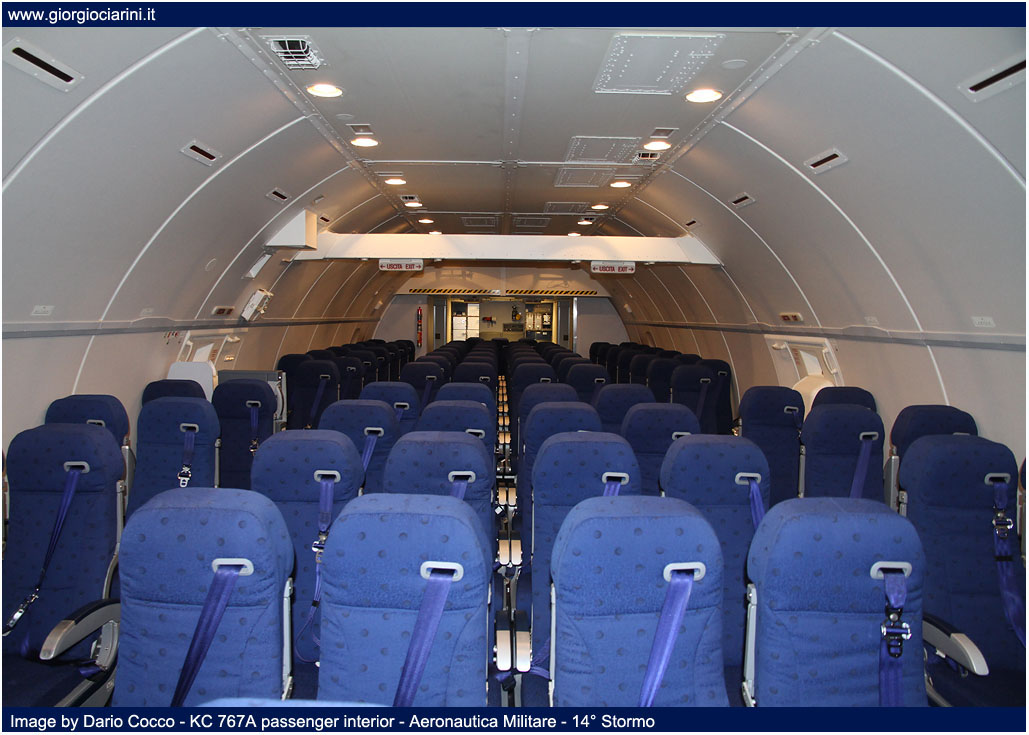
Per quanto riguarda la capacità di trasporto l’aeromobile può essere allestito in tre diverse configurazioni:
-Combi, in questa versione si possono imbarcare fino a 100 passeggeri più dieci pallets 463L sul ponte principale, nella stiva inferiore trovano posto tre pallets 463L più tre LD4, oppure un totale di nove LD4, il peso massimo raggiungibile per questa versione è stabilito in 55.000 libbre.
-Full Pax si possono imbarcare fino a 200 passeggeri nel ponte principale, mentre nella stiva inferiore si possono imbarcare tre pallets 463L più tre LD4, oppure un totale di nove LD4, per un totale massimo di 50.000 libbre.
-Full Cargo si possono imbarcare un totale di 19 pallets 463L se posizionati “side by side” sulle fiancate laterali, oppure dieci 463L su di un'unica fila centrale “centerline”, la capacità della stiva inferiore rimane invariata rispetto alle precedenti configurazioni, sale però a 64.000 libbre il peso totale.
Per quanto riguarda invece le capacità come tanker il 767 è in grado di rifornire tutte le tipologie di velivoli esistenti, e di essere rifornito a sua volta. |
|
|
Il velivolo è predisposto con quattro punti di rifornimento (multipoint), tre del tipo a cestello, per questa tipologia di rifornimento il velivolo ricevente deve essere predisposto con una sonda esterna che si aggancia al cestello, e una ad asta rigida che invece viene inserita tramite il boomer nel ricettacolo presente su alcune tipologie di aeromobili, i KC 767 possono rifornire simultaneamente solo con i pod subalari.
Tramite il sistema di rifornimento High Speed Flying Boom (Asta rigida) si può rifornire un solo velivolo per volta trasferendo carburante fino ad un massimo di 4.091 litri al minuto
Leggermente arretrato rispetto all’ARB (Aerial Refueling Boom) è presente un punto di rifornimento Hose-and-Drogue, da dove si può rifornire un solo velivolo per volta trasferendo carburante fino a 2.727 litri al minuto.
Infine ci sono i due pod subalari sempre di tipo a cestello (Hose-and-Drogue) dove invece si possono rifornire due velivoli contemporaneamente trasferendo ad ognuno un massimo di 1.818 litri al minuto.
Il KC 767A è in grado di essere rifornito (receiver) a sua volta tramite l’UARRSI (Universal Aerial Refueling Receptacle Slipway Installation) posto sopra la cabina di pilotaggio, in questo caso può essere usata solo la sonda rigida per effettuare il travaso di carburante.
Il rifornimento in volo viene gestito tramite una postazione collocata subito dietro la cabina di pilotaggio denominata RARO II (Remote Aerial Refueling Operator Station), la stazione è composta da due postazioni, una principale dove trova posto il boomer, mentre l’altra può essere utilizzata indistintamente da un altro boomer, molto apprezzata in caso di missioni particolarmente lunghe, oppure può essere utilizzata da un istruttore per le missioni addestrative. |
|
|
La postazione principale del boomer dispone di due joystick per effettuare le manovre, il comando di sinistra serve per la gestione del telescopio, per le luci di indicazione di manovra, per la manovra di sgancio d’emergenza (breakway) o per la disconnessione normale, i comandi di destra servono invece per gestire la radio, le regolazioni azimuth e orizzontali della sonda rigida.
Per le operazioni di supervisione e gestione l’operatore si avvale inoltre di due schermi (touch screen) dove vengono visualizzate le riprese video e la situazione del carburante presente nei serbatoi, i serbatoi del 767 servono per alimentare sia i motori del velivolo che per rifornire i “receiver”, un sistema automatico gestisce i travasi per mantenerli equilibrati verso il contenitore centrale.
Le riprese video avvengono tramite un RVS (Remote Vision System) dotato di tre telecamere che riprendono la zona esterna esattamente dove avviene il contatto con l’aeromobile da rifornire, due sono laterali per le riprese dei pod subalari, una inquadra il cestello e l’ARB, per quest’ultima visuale è stata installata un ulteriore telecamera ad infrarossi per le operazioni notturne. L’RVS è un pod ventrale installato nella parte posteriore inferiore prossima alla zona di attacco dell’asta rigida. Un ulteriore importante dotazione a disposizione dell’ARO (Aerial Refueling Opeartor) è l’HMD System (Head Mounted Display), l’HMD è un casco che permette la vista stereoscopica delle immagini visualizzate sullo schermo quando si utilizza il Flying Boom, non avendo il contatto visivo con l’aereo receiver, come per esempio avviene sui KC 135, è importantissimo vedere l’aereo da rifornire in modo tridimensionale a vantaggio della percezione reale delle distanze.
Attualmente il 14° Stormo mantiene una configurazione dei velivolo combinata con due Combi, un Full Pax e un Full Cargo, ritenuta la più adatta per le tipologie di missione svolte in questo periodo, però come già accennato precedentemente queste configurazioni si possono variare con poche ore di lavoro. |
 |
|
Caratteristiche tecniche
Lunghezza: 48,51 mt
Apertura alare: 47,57 mt
Altezza: 15,85 mt
Propulsione: 2 Turbofan General Electric CF6-80C2 da 60.200 libbre di spinta ognuno (268kn)
Peso massimo al decollo: 180.000 kg
Peso a vuoto: 82.000 kg
Peso massimo carburante imbarcabile: 70 tonn
Tangenza operativa: 13.000 mt
Autonomia: 14 ore
Raggio d’azione: 11.500 km
Velocità di crociera: 900 km/h (0.80 mach)
|
|
|
|
English translation
The KC 767A is a variant of the commercial model B 767-200ER (Extended Range), the 767 is a twin-engine jet designed and built for civil transport by the American company Boeing Commercial Aircraft. With over 1,000 aircraft built in versions 200, 300 and 400 the aircraft is characterized by a wide fuselage (Wide body) and low wing, a spacious and comfortable interior layout, low fuel consumption, excellent operational flexibility, a low internal noise level and fully digital avionics. The design dates back to the late 1970s, while production began in 1981, the B 767 was designed with the same cockpit configuration as the smaller B 757.
In the military the aircraft has been chosen as a carrier for in-flight refueling and strategic transport by the Aeronautica Militare, Japan and the United States, the version for the USAF will be called KC 46-2C, the latter will feature a cockpit with many components of the B 787 Dreamliner and the same Flying Boom (fly-by-wire) of the KC 10A, the planned 179 American aircraft will replace all KC 135 in service.
The four KC 767A in service at the 14° Stormo may be used at the same time as a carrier for in-flight refueling and as carriers for the transport of cargo and personnel, the internal configuration can be varied according to the operational needs in a few hours of work.
As regards transport capacity, the aircraft can be equipped in three different configurations:
-Combi, in this version he can board up to 100 passengers plus ten pallets 463L on the main deck, in the lower deck there are three pallets 463L plus three LD4, or a total of nine LD4, the maximum weight achievable for this version is set at 55,000 pounds.
-Full Pax can board up to 200 passengers in the main deck, while in the lower hold you can board three pallets 463L plus three LD4, or a total of nine LD4, for a maximum total of 50,000 pounds.
-Full Cargo he can embark a total of 19 pallets 463L if placed "side by side" on the side, or ten 463L on a single central row "centerline", the capacity of the lower deck remains unchanged compared to previous configurations, However, the total weight rises to 64,000 pounds.
As for tanker capabilities, the 767 is able to supply all types of existing aircraft, and to be supplied in turn.
The aircraft is equipped with four refueling points (multipoint), three of the basket type, for this type of refueling the receiving aircraft must be equipped with an external probe that attaches to the basket, and a rigid rod that instead is inserted through the Boomer in the receptacle present on some types of aircraft, the KC 767 can supply simultaneously only with the sub pods.
Through the High Speed Flying Boom (rigid rod) refueling system he can refuel only one aircraft at a time transferring fuel up to a maximum of 4,091 liters per minute
Slightly behind the ARB (Aerial Refueling Boom) there is a Hose-and-Drogue refueling point, from where can refuel only one aircraft at a time transferring fuel up to 2,727 liters per minute.
Finally there are the two sub-pods always basket type (Hose-and-Drogue) where instead he can refuel two aircraft simultaneously transferring to each a maximum of 1,818 liters per minute.
The KC 767A is able to be refueled (receiver) via the UARRSI (Universal Aerial Refueling Receptacle Slipway Installation) located above the cockpit, in this case only the rigid probe can be used to carry out the transfer of fuel.
The refueling in flight is managed through a station located just behind the cockpit called RARE II (Remote Aerial Refueling Operator Station), the station consists of two stations, a main one where the Boomer is located, while the other can be used indiscriminately by another Boomer, highly appreciated in the case of particularly long missions, or can be used by an instructor for training missions.
The main station of the Boomer has two joysticks to carry out the maneuvers, the left command serves for the management of the telescope, for the indication lights of maneuver, for the emergency release maneuver (break way) or for the normal disconnection, The right controls are used instead to manage the radio, azimuth and horizontal adjustments of the rigid probe.
For supervision and management operations, the operator also uses two screens (touch screen) where the video footage and the fuel situation in the tanks are displayed, the 767’s tanks serve to power both the aircraft engines and to supply the "receivers", an automatic system manages the transfers to keep them balanced towards the central container.
The video is taken via a RVS (Remote Vision System) equipped with three cameras that capture the external area exactly where the contact with the aircraft to be refueled, two are side for the filming of the pods, one frames the basket and the ARB, an additional infrared camera has been installed for night operations. The RVS is a ventral pod installed in the lower back close to the attachment zone of the rigid rod. A further important equipment available to the ARO (Aerial Refueling Operator) is the HMD System (Head Mounted Display), the HMD is a helmet that allows the stereoscopic view of the images displayed on the screen when using the Flying Boom, not having visual contact with the receiver plane, as for example happens on the KC 135, it is very important to see the plane to be refueled in a three-dimensional way to the advantage of the real perception of distances.
Currently, the 14° Stormo maintains a configuration of the aircraft combined with two Combi, a Full Pax and a Full Cargo, considered the most suitable for the types of missions carried out in this period, but as already mentioned above these configurations can vary with a few hours of work.
Technical characteristics
Length: 48.51 m
Wingspan: 47.57 m
Height: 15.85 m
Propulsion: 2 Turbofan General Electric CF6-80C2 from 60.200 pounds of thrust each (268kn)
Maximum take-off weight: 180,000 kg
Empty weight: 82,000 kg
Maximum fuel weight: 70 tons
Operating tangency: 13,000 m
Operating time: 14 hours
Operating range: 11,500 km
Cruising speed: 900 km/h (0.80 mach)
|
|