|
36° Stormo
|
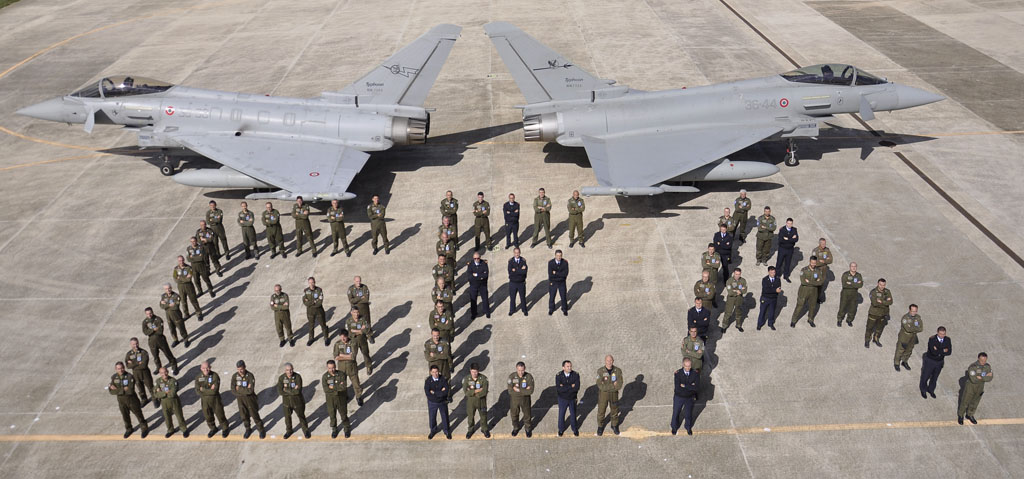 |
Nel 1971 inizia l’attività manutentiva del Reparto sui vari velivoli che si sono succeduti negli anni in carico allo Stormo, una storia densa di riorganizzazioni, avvenimenti e attività di elevato contenuto tecnologico affrontate dai suoi uomini in un costante sforzo tecnico-operativo mutato negli anni nella forma, ma mai nella sostanza. La sua ultima ristrutturazione con relativo cambio di designazione (da CM a GEA) risale al 1° novembre del 2007, in concomitanza dell’arrivo a Gioia del Colle del nuovo caccia F 2000A Typhoon. Per creare questo nuovo soggetto sono stati accorpati due reparti molto diversi tra loro, il CM (Centro Manutenzione) e la linea volo con i suoi “crew chief” (capi velivolo), che con caratteristiche diverse tra loro e con un buon lavoro di “cucitura” si è dimostrato molto efficace. Il compito più difficile è stato quello di non far perdere l’attaccamento al proprio ruolo a quegli uomini che hanno sempre lavorato a stretto contatto con il reparto di volo, il fondamento di una perfetta sintonia in linea di volo è la collaborazione continua, ora integrata in una nuova realtà molto diversa.
Oltre alla fusione di due distinti soggetti, il GEA ha affrontato anche una sfida tecnologica di rilievo, passando da un velivolo come il Tornado, entrato in servizio nei primi anni 80, ad uno di 4ª Generazione plus (quasi di 5ª) come il Typhoon, uno dei caccia più moderni ed evoluti al mondo.
Attualmente il GEA di Gioia del Colle si pone all’interno della catena manutentiva del velivolo F 2000 Typhoon a pieno titolo, sequenza che vede Eurofighter come consorzio produttore, NETMA (NATO Eurofighter 2000 and Tornado Management Agency) come interlocutore tra industria e forze aeree, Comando Logistico Aeronautica Militare come ente superiore di forza armata, 1° RMV (Reparto Manutenzione Velivoli) come gestore e manutentore della flotta, 936° GEA (Gruppo Efficienza Velivoli) come reparto manutentore dell’intera flotta e gestore dei velivoli in carico al 36° Stormo, con capacità manutentive parificate al 1° RMV.
Il GEA dipende direttamente dal Comandante di Stormo, il Direttore del GEA è al comando dell’ente, esso si avvale di una Segreteria di Comando, di un Ufficio Tecnico, di una Direzione Tecnica Operazioni e di una Sezione Controllo e Qualità.
L’Ufficio Tecnico si occupa della gestione delle prescrizioni tecniche, emana gli ordini tecnici di lavoro per la Direzione Tecnica, aggiorna la documentazione tecnica, ha il controllo di configurazione e di scadenza.
La Direzione Tecnica Operazioni è un po’ più articolata, è in sintesi il “braccio operativo” del Gruppo.
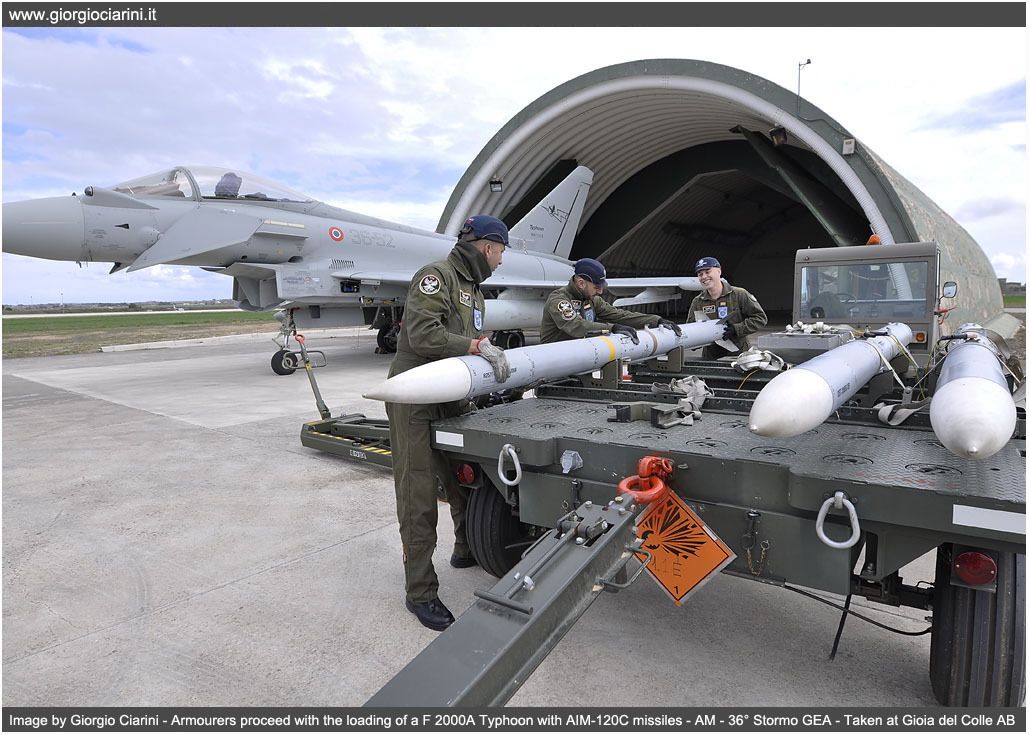
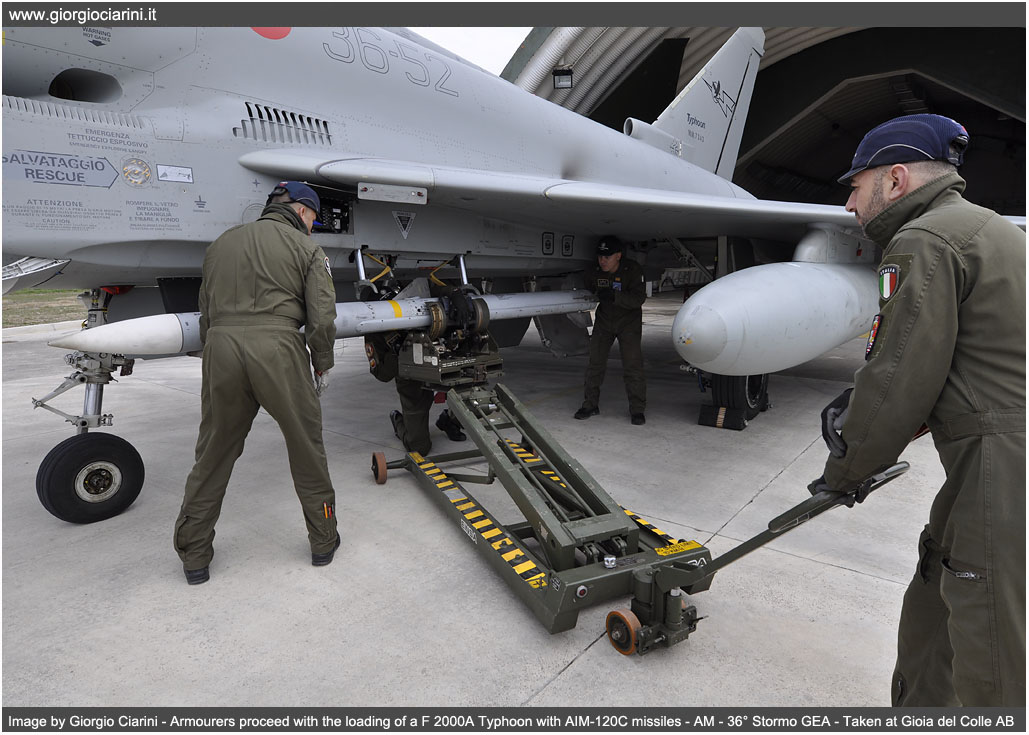
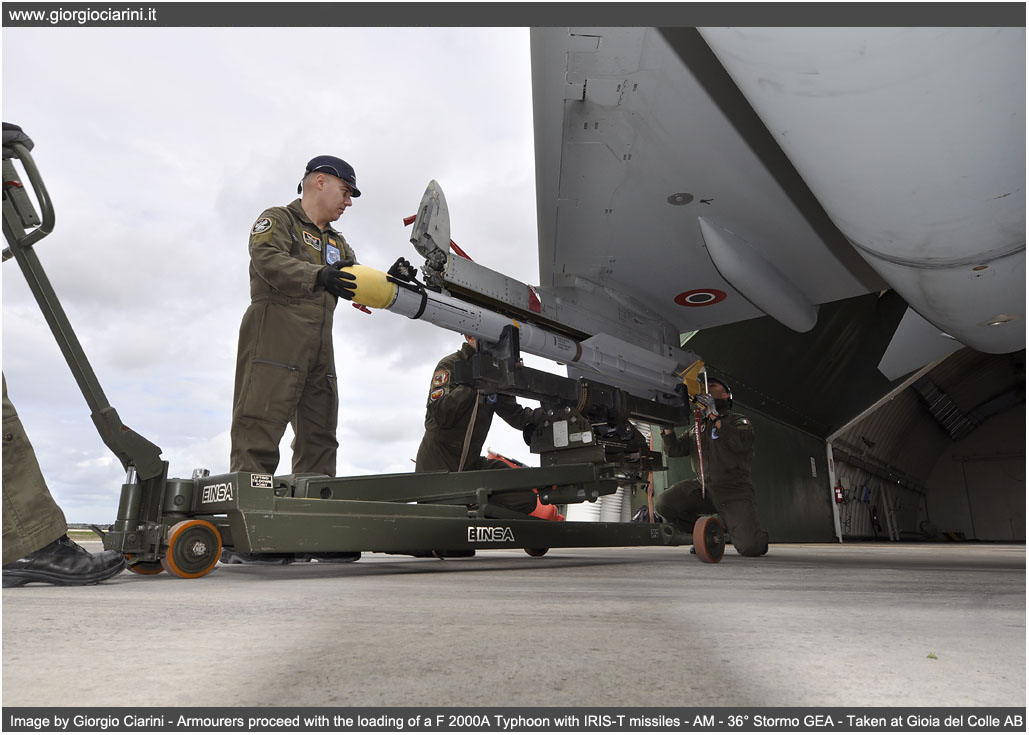
Tramite i propri specialisti effettua le ispezioni di 1° Livello Tecnico direttamente in linea volo per tutte le categorie (avionici, montatori, armieri, meccanici ecc.ecc.) e di supporto per gli equipaggiamenti.
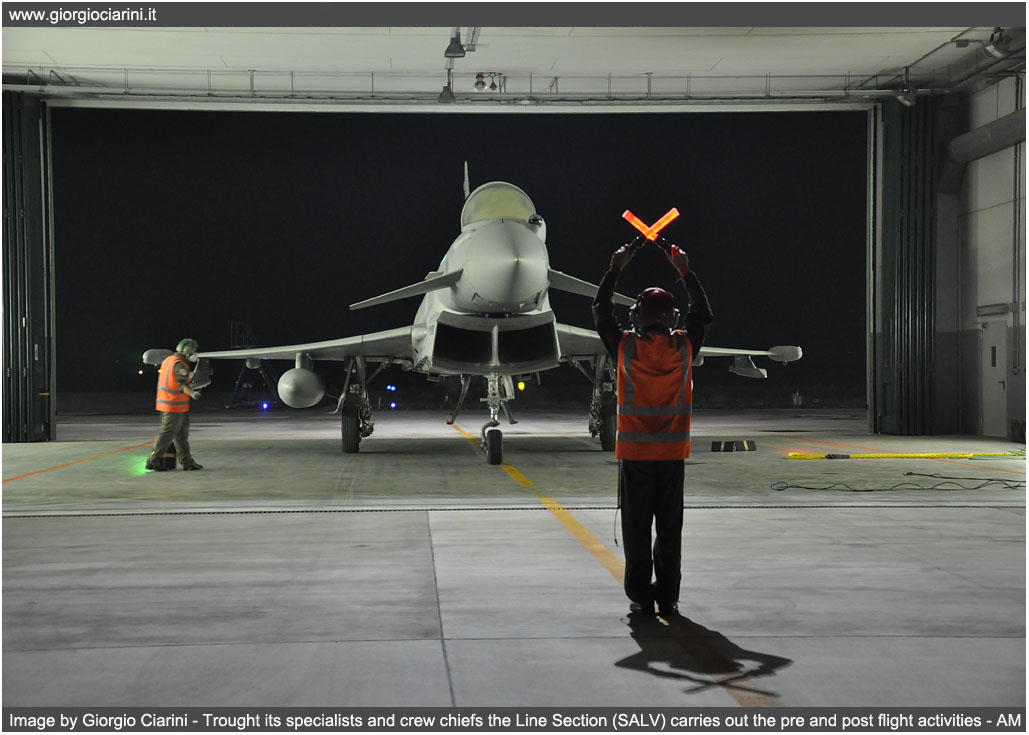
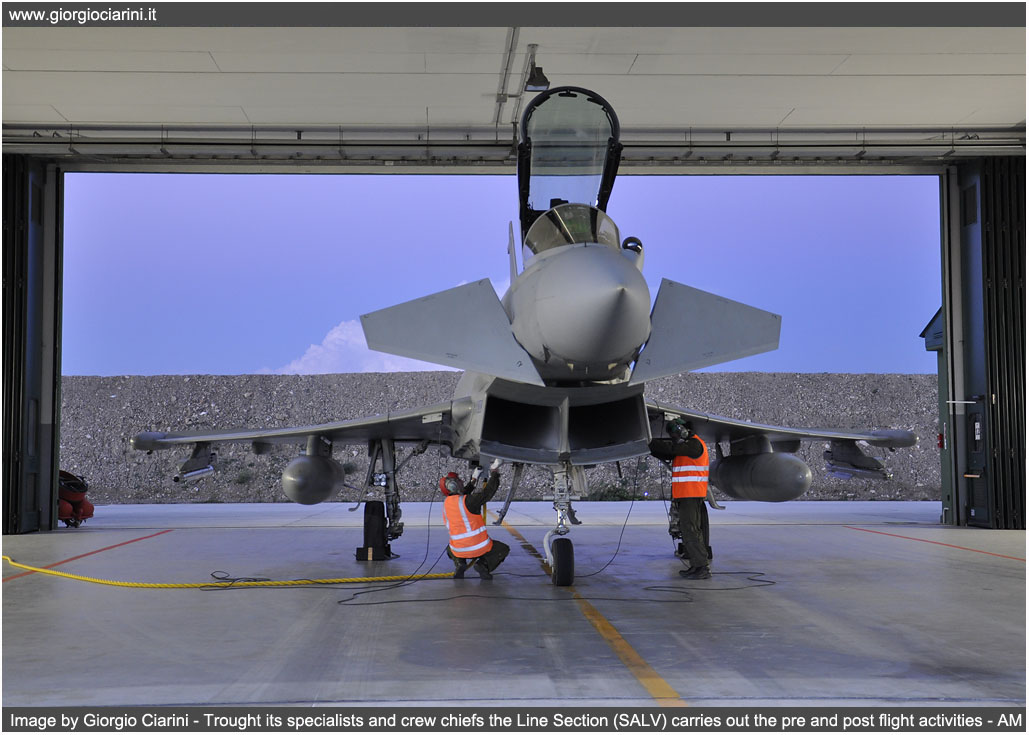
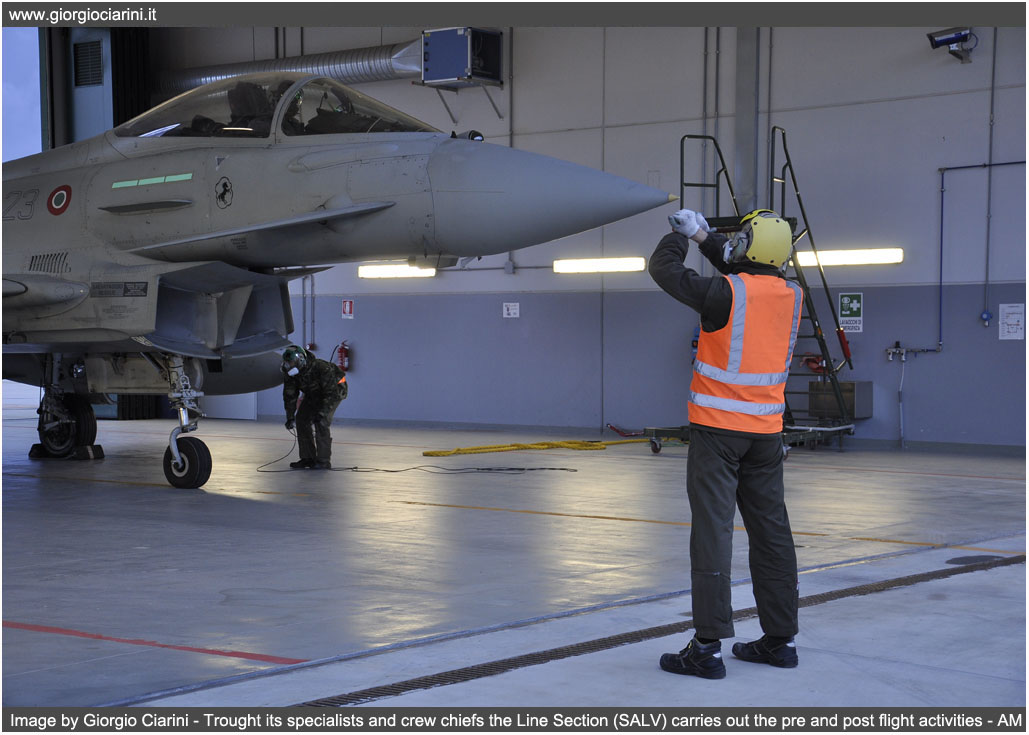
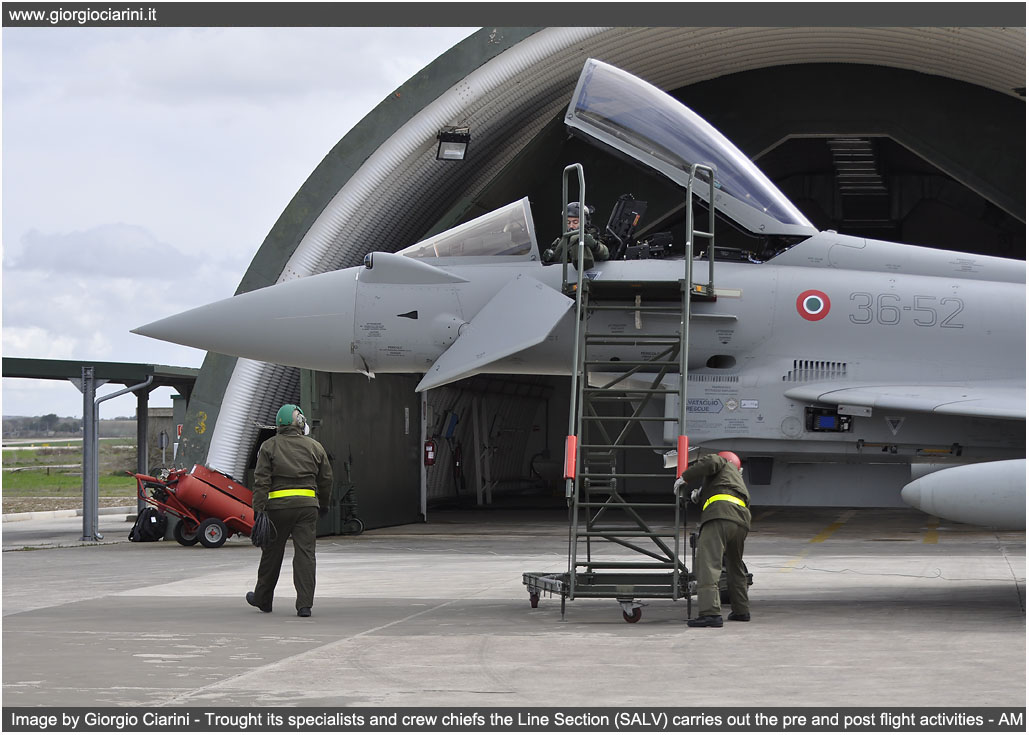
Gestisce la SALV (Sezione Approntamento Linea di Volo) tramite i propri “crew chief” nelle normali operazioni pre e post volo.
Compie la manutenzione correttiva e ordinaria LIC (Limite Impiego Calendariale) e LOF (Limite Operativo Funzionale) svolte tra un Ispezione Programmata (IP) e quella superiore.
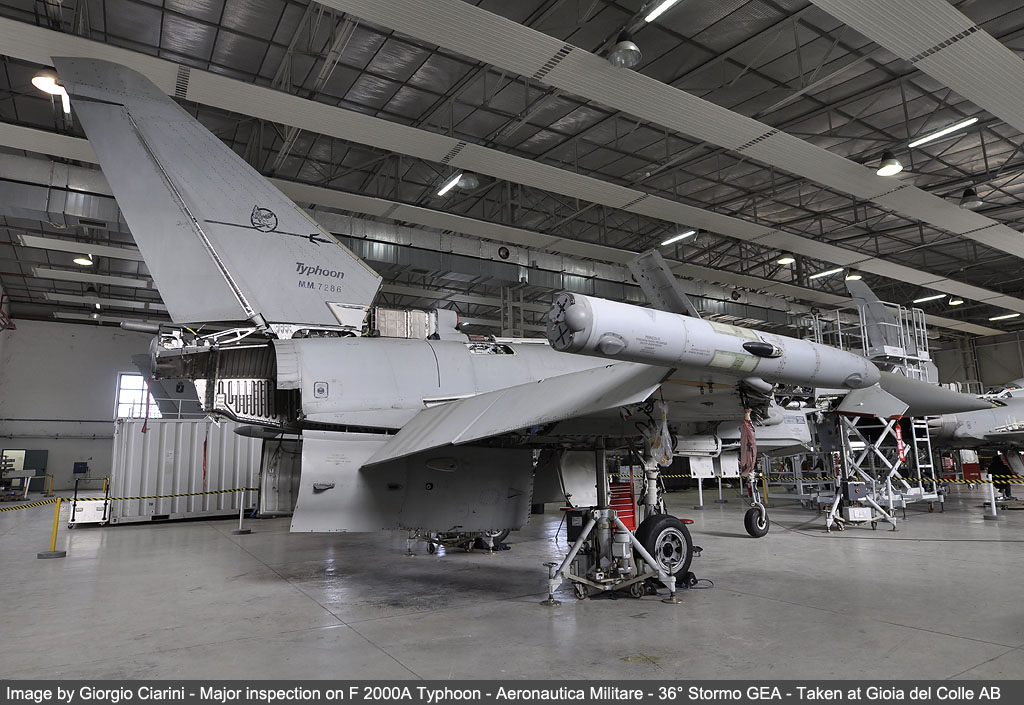
Svolge manutenzioni in hangar di 2° Livello, gli interventi di questo tipo sono calendarizzati alle 500 ore di volo del velivolo, dal gennaio del 2014 sostituisce la IP delle 400 ore, delle “mini ispezioni” sulle 400 ore sono svolte per alcuni sistemi non ancora certificati per le 500, come per esempio i comandi di volo, queste “mini ispezioni” o “Delta 400” comportano solitamente un fermo macchina di circa due settimane.
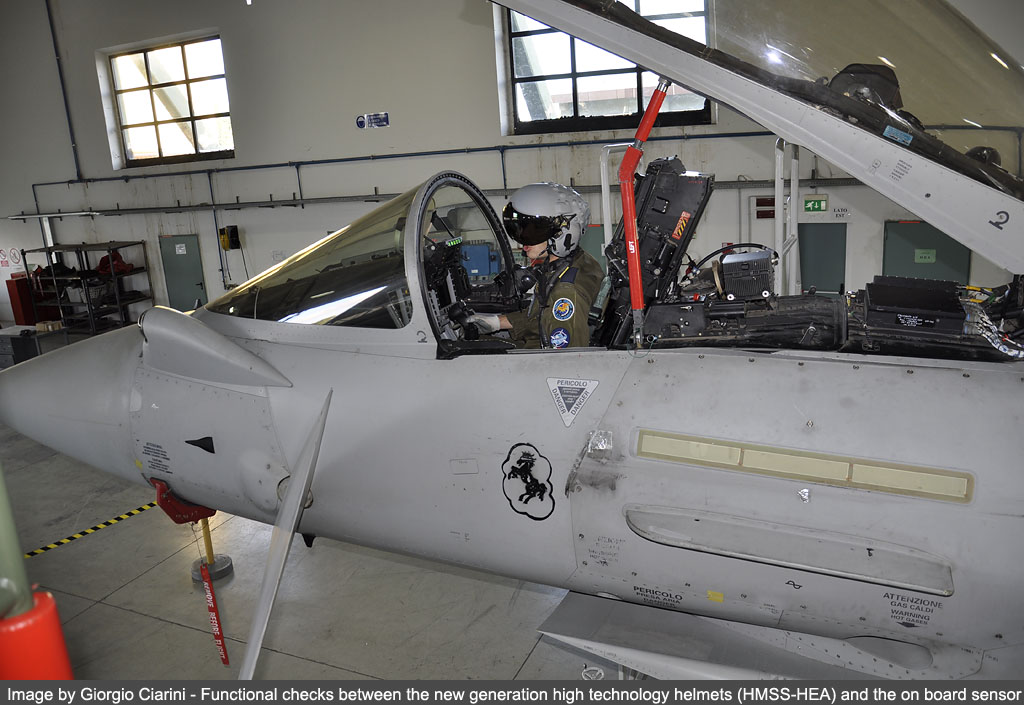
Ritornando alle IP delle 500 ore, molto più complesse e lunghe, s’interviene su tutti i sistemi del velivolo, si eseguono i Controlli Non Distruttivi (CND), si effettuano riparazioni ed eventuali sostituzioni, e soprattutto, considerato che il Typhoon è un velivolo in continua evoluzione, si effettuano gli aggiornamenti di configurazione, in particolare degli “hardware” e “software” che gestiscono i sistemi di bordo, o addirittura la sostituzione degli impianti per implementare il velivolo all’utilizzo del casco HMSS o dei Pod Litening III e RecceLite.
Va anche detto che l’IP di 2° Livello svolta dal GEA è la più “invasiva” compiuta sul Typhoon, una volta era la cosiddetta IP di 3° Livello o IRAN (Inspection and Repair As Necessary) e svolta solitamente dal costruttore, ora non più necessaria grazie al sistema di controllo strutturale che l’F 2000 ha a bordo e che tramite sensori inseriti in tutta la struttura lo monitorizza costantemente.
Per chiudere il capitolo sulla Direzione Tecnica va detto che le sei aree a lei assoggettate includono:
-Sezione linea volo
-Sezione armamento
-Sezione manutenzione meccanica
-Sezione manutenzione avionica
-Sezione manutenzione propulsori
-Sezione tecnici generali
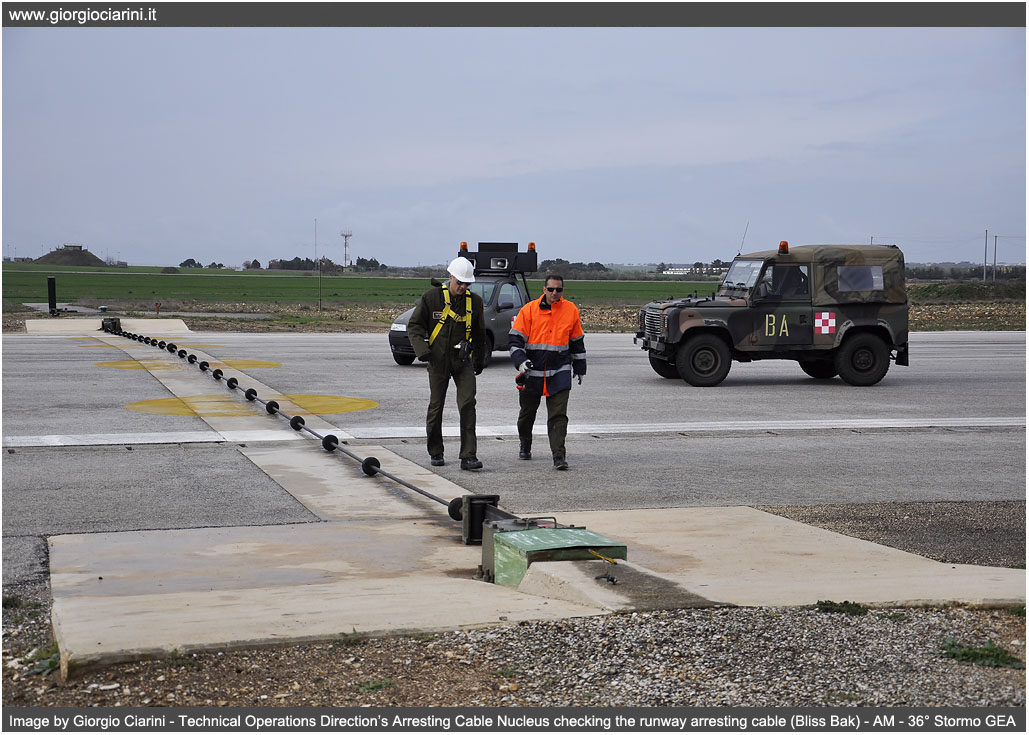
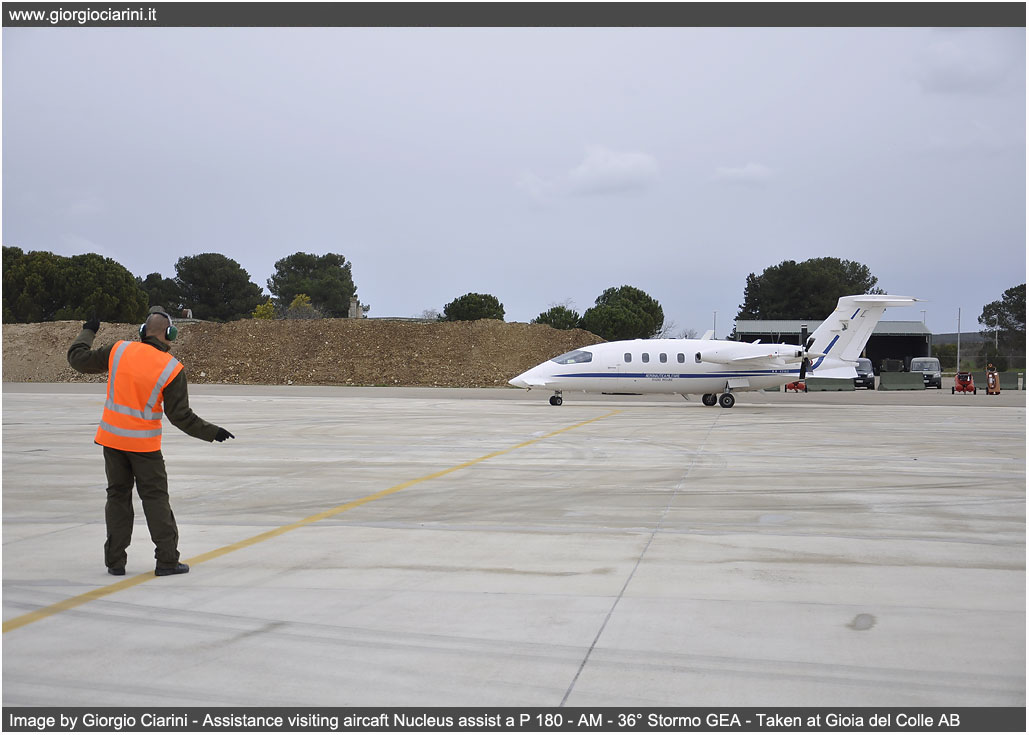
Le sezioni includono al loro interno una moltitudine di sotto aree, per esempio, l’assistenza dei velivoli di passaggio, le barriere di arresto, le sale pneumatici, metrologica, seggiolini, equipaggiamento ecc. ecc..
Terminiamo con la Sezione Controllo Qualità.
I compiti principali sono il controllo di qualità delle lavorazioni sul velivolo, stilare le procedure in aderenza sulle normative per le ispezioni e il rilascio dei documenti, il controllo del livello di addestramento del personale, il controllo della politica di gestione, ma soprattutto il mantenimento del reparto agli standard della Certificazione ISO9001/2015 e il rispetto dei criteri di Aeronavigabilità AERP2005 di ogni singolo velivolo.
Il 936° GEA, nonostante la piena maturità nella gestione delle proprie attività manutentive, mantiene ancora in essere una proficua “joint venture” con il personale di Leonardo Finmeccanica in particolare per le attività di 2° Livello Tecnico, collaborazione necessaria considerato il contratto di supporto logistico stipulato tra la forza armata e l’industria. |
 |
|
|
 |
|
|
Per rappresentare al meglio le attività svolte dal GEA analizziamo alcuni lavori che vengono svolti costantemente, è ovviamente impossibile vederli tutti, ho cercato di evidenziare alcuni processi non” usuali” da vedere.
Prova di emergenza estensione carrello di atterraggio
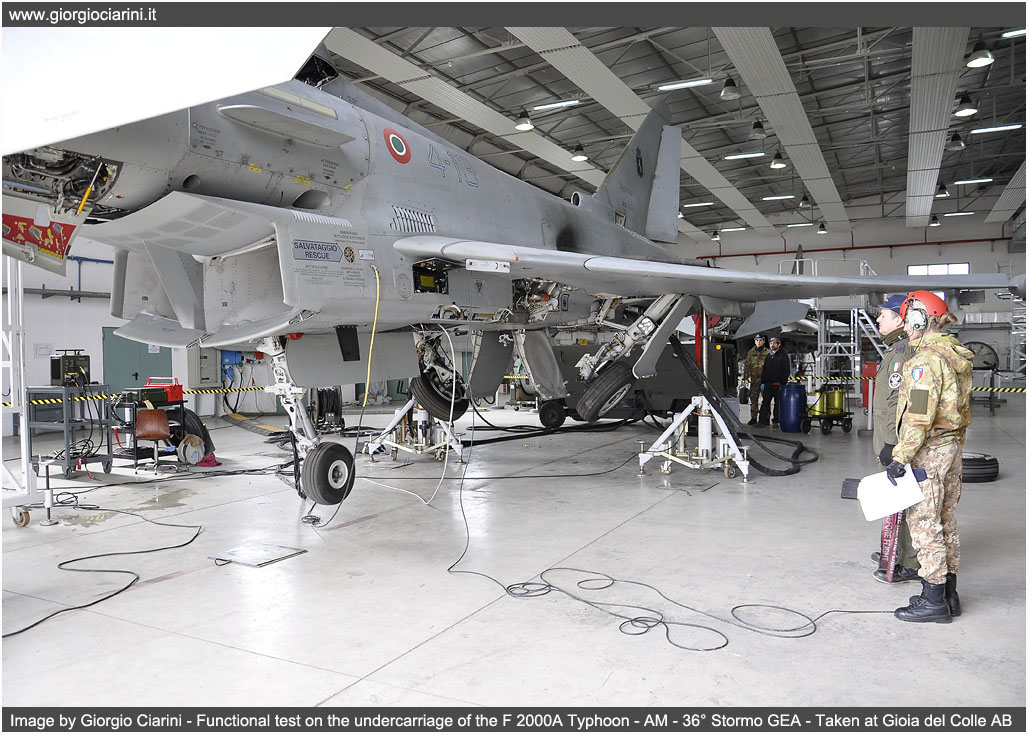
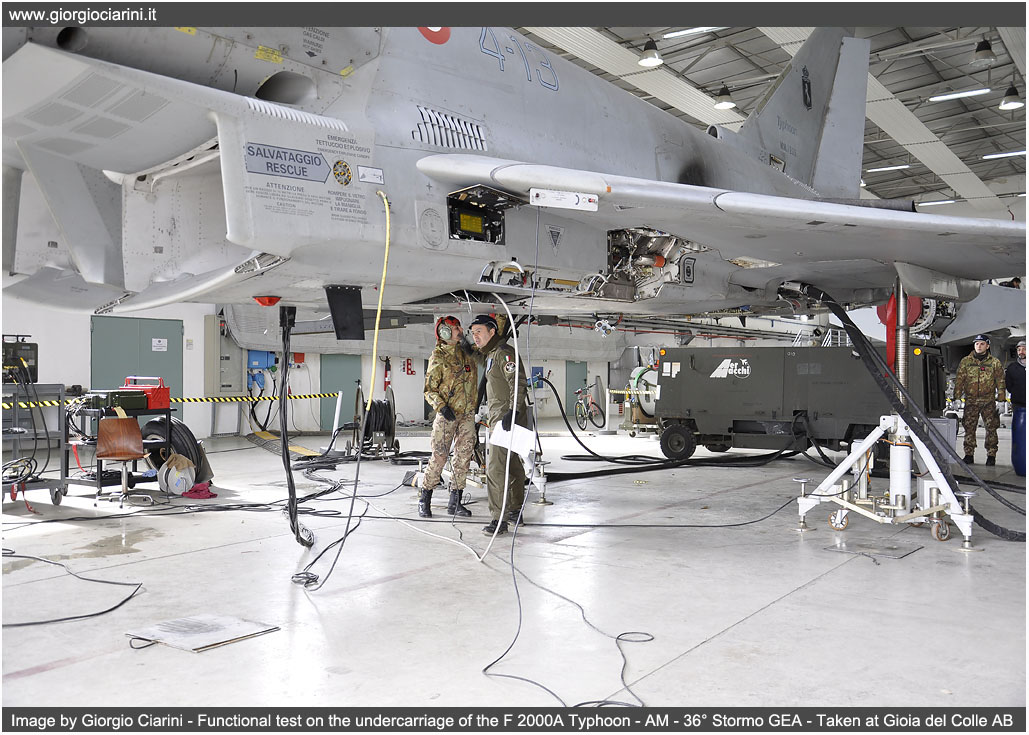
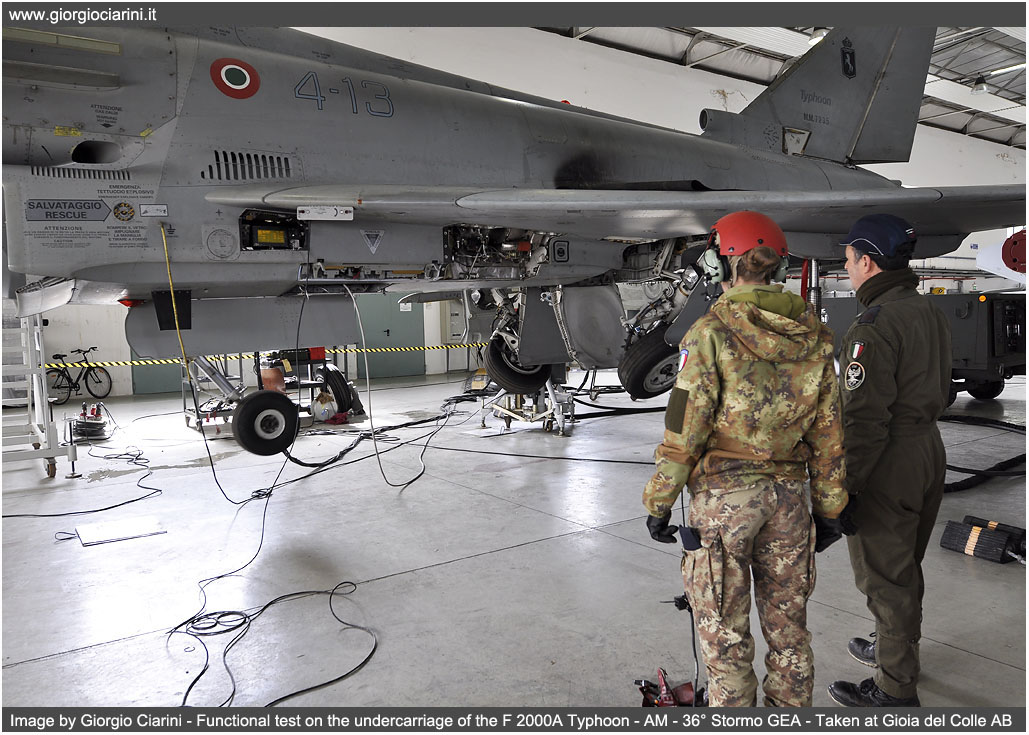
Questa operazione viene svolta nella fase finale delle ispezioni programmate, poco prima di eseguire i test funzionali esterni, il velivolo viene sollevato con degli appositi martinetti in modo che il carrello non appoggi a terra, tramite un impianto idraulico esterno il carrello viene fatto risalire negli appositi alloggiamenti, tolta la pressione idraulica, con un apposito comando lanciato dallo specialista manutentore posizionato nel cockpit il carrello viene rilasciato, per gravità deve estrarsi, questa manovra è indispensabile nel caso di avaria idraulica. Il test viene ripetuto più volte.
Manutenzione seggiolino eiettabile
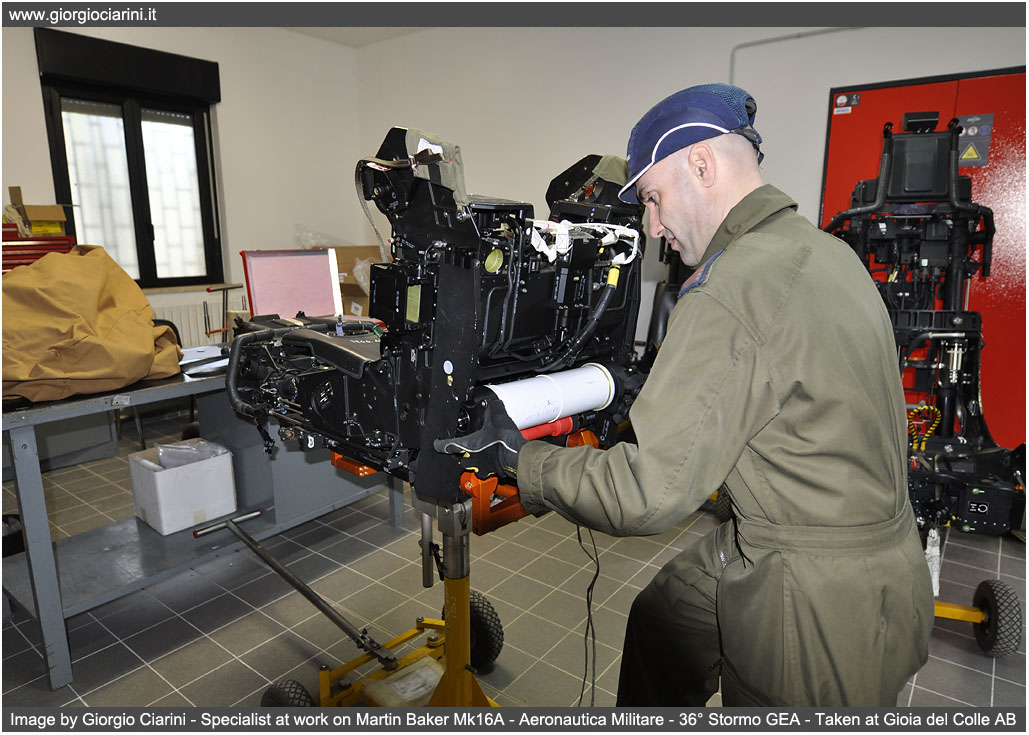
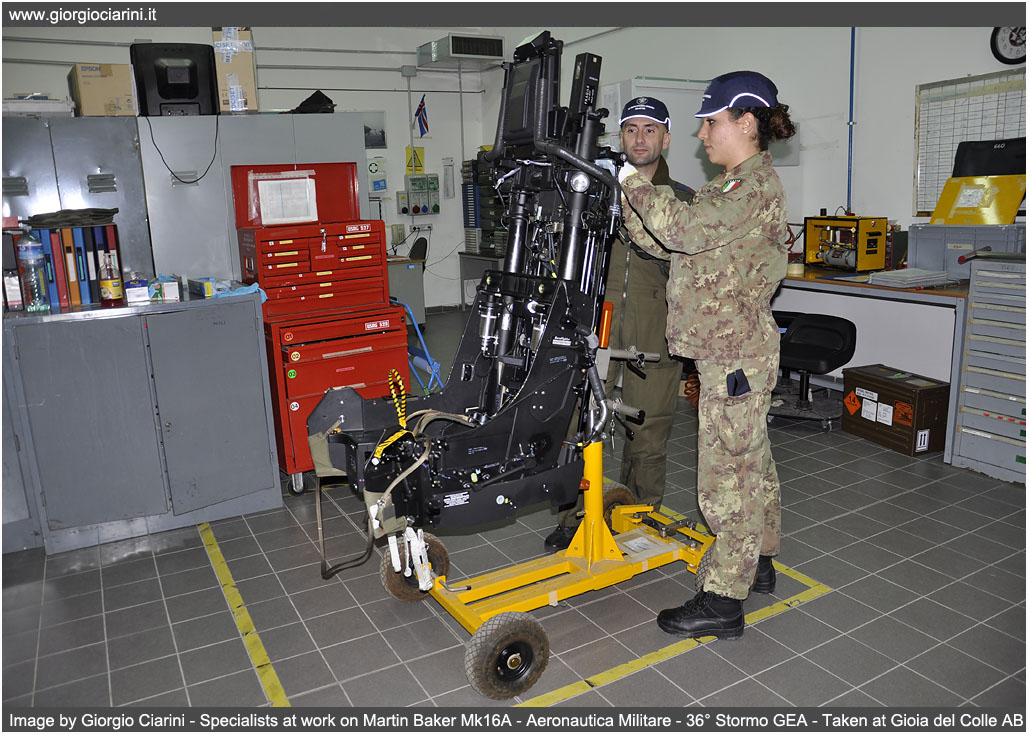
Il seggiolino eiettabile Martin Baker 16A è un componente indispensabile per la sopravvivenza del pilota in caso di incidente, mantenerlo efficiente è una priorità per l’ente manutentivo.
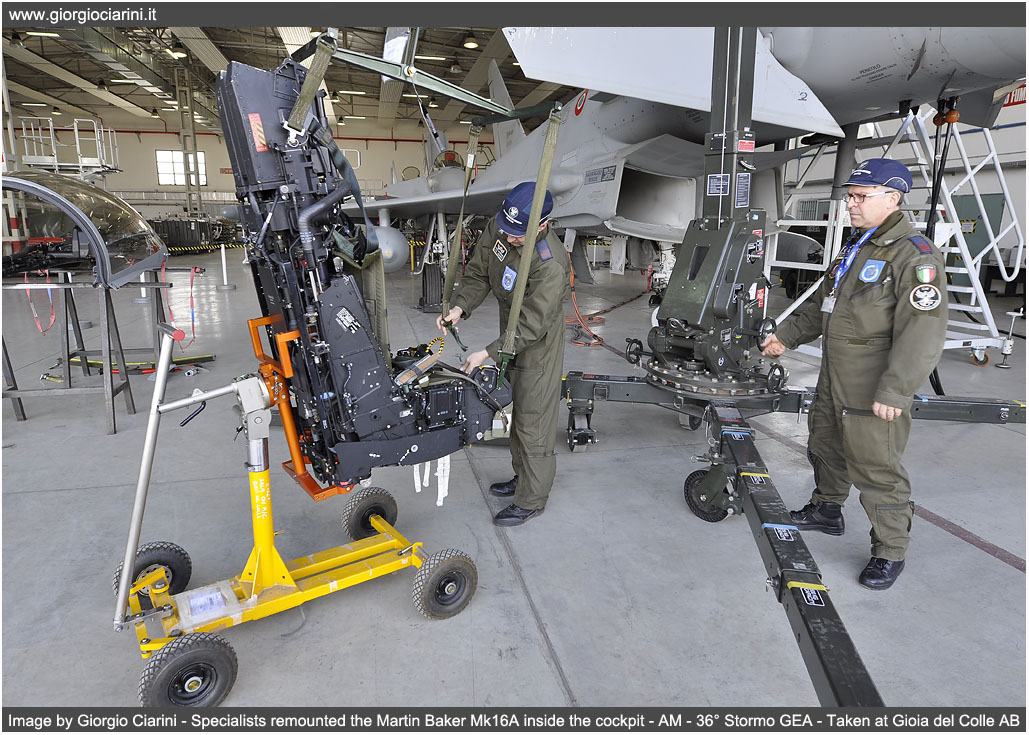
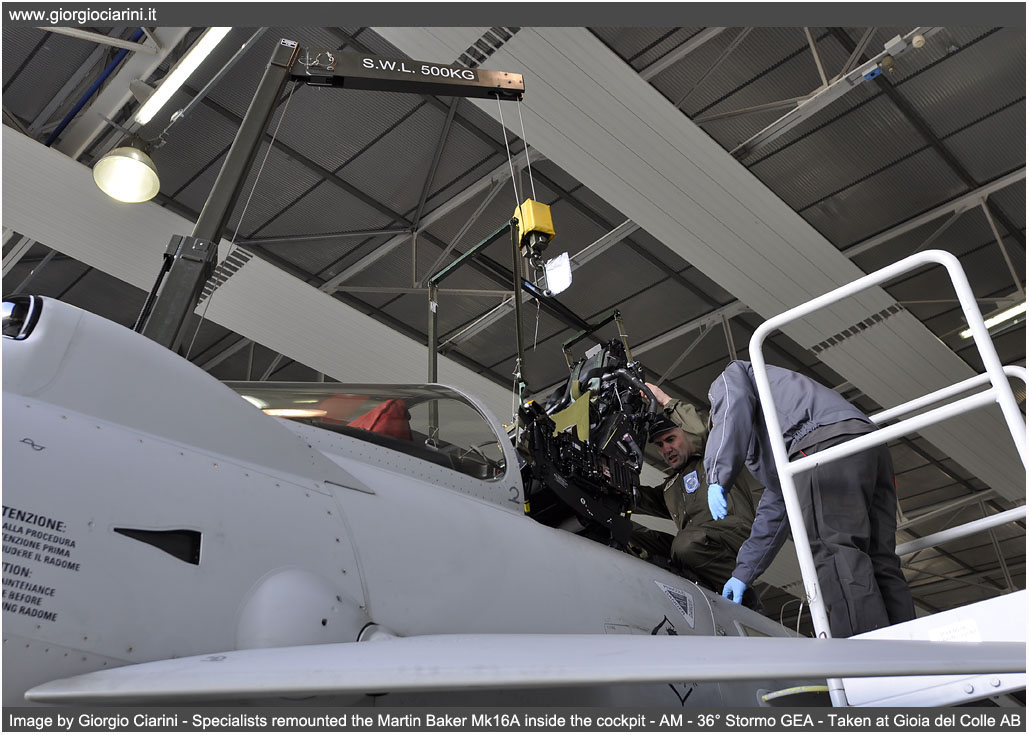
Il seggiolino dopo essere stato smontato viene portato in una sala apposita a prova di scoppio dove vengono sostituiti i sistemi pirotecnici di lancio e l’USRM (Under Seat Rocket Motor), le cartucce pirotecniche servono a far uscire il seggiolino dal velivolo e separare il pilota da esso, mentre il motore a razzo per farlo allontanare e per stabilizzarlo in base all’assetto di lancio. Ci sono tre tipologie di armamenti, per il velivolo monoposto la serie è composta da 14 + 1 cartucce, per il velivolo biposto le cartucce sono 16 + 1 e diverse tra posto anteriore e posteriore. Una volta sostituite, e prima del riposizionamento del seggiolino sul velivolo, viene eseguito un test elettrico alle quattro cartucce gestite da un sequencer e che servono alla separazione pilota/seggiolino. Il rimontaggio avviene tramite una particolare gru che alza il seggiolino fino a posizionarlo nel cockpit.
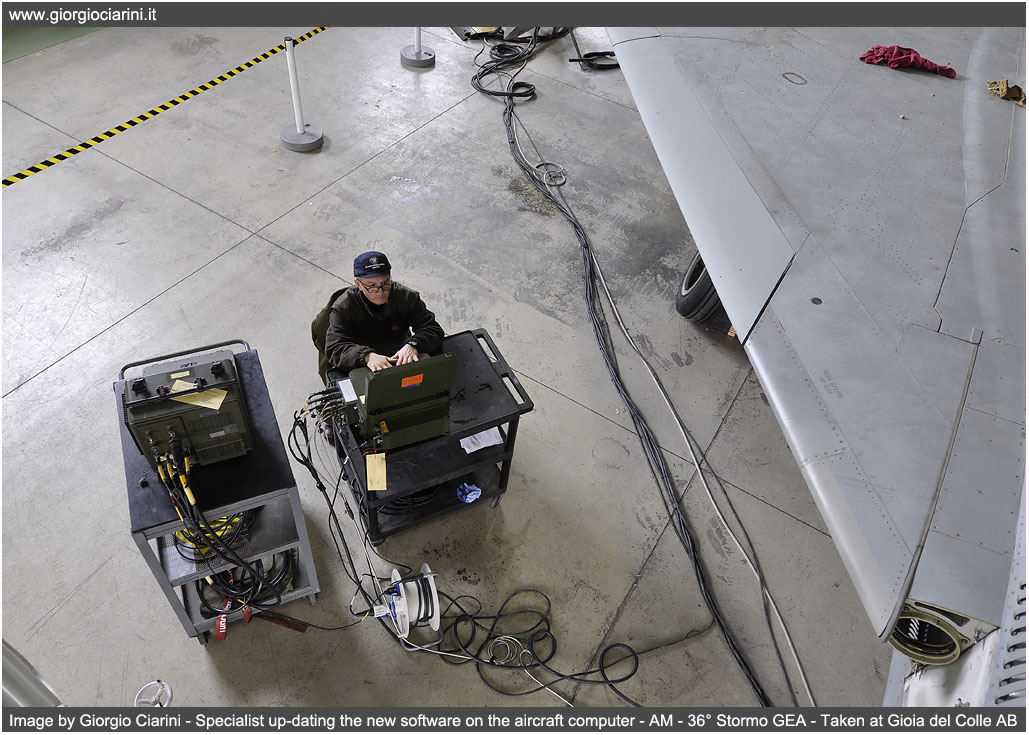
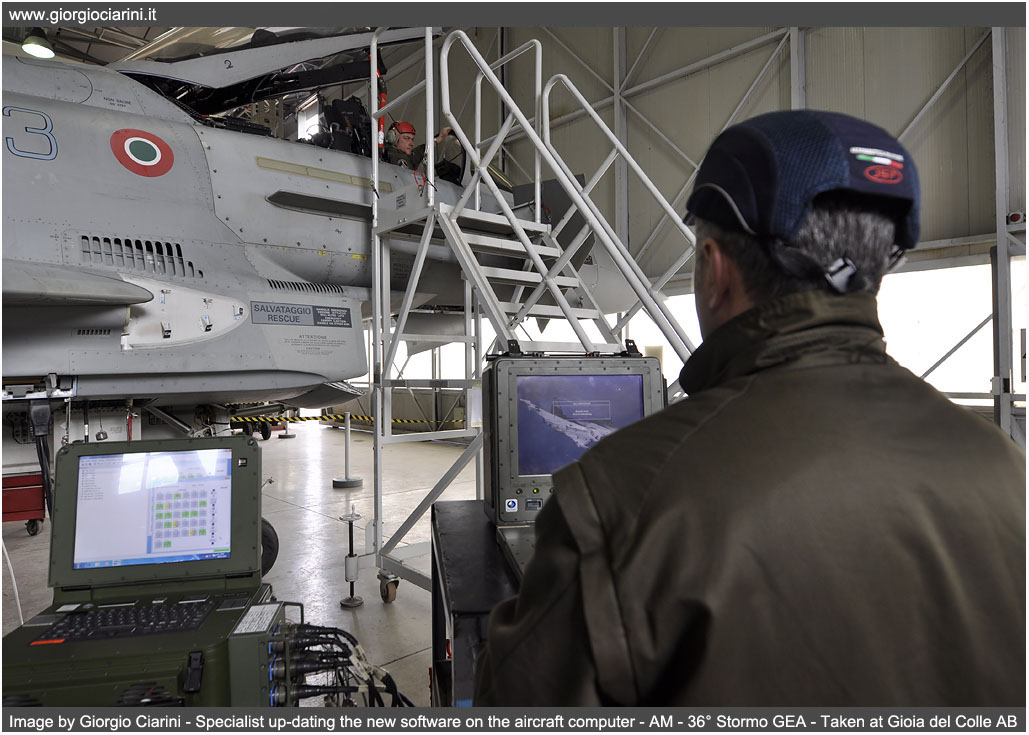
Aggiornamento software di bordo e verifica funzionalità hardware.
Durante qualsiasi ispezione programmata una delle operazioni previste è l’aggiornamento dei software. Tramite il Ground Loud Unit (GLU) vengono trasferiti via bus il nuovo software al velivolo. Un’altra operazione simile viene fatta tramite l’High Level Bus Analyser (HLBA), l’HLBA controlla invece lo stato dei collegamenti via bus dei computer di bordo, eseguendo dei test dedicati verifica le loro funzionalità. |
|
|
Il GEA rappresenta all’interno di uno Stormo l’identità più complessa, sia come tipologia di lavorazioni eseguite ma anche come numero di militari assegnati. Una struttura molto articolata che ha anche come particolarità di avere pochissimi Ufficiali all’interno, tutti ovviamente posti nelle posizioni chiave, ma moltissimi Sottufficiali.
Nel caso del GEA i Sottufficiali svolgono per lo più attività specialistiche, per elencarne alcune vediamo: motorista, avionico, elettromeccanico, armiere, montatori.
Per preparare uno “specialista” servono anni di addestramento teorico e pratico, attualmente l’iter di preparazione previsto per formare gli “specialisti manutentori” a seconda del ruolo di appartenenza, e il seguente vediamo come vengono formati.
La prima fase viene svolta facendo un corso basico presso una Scuola di Formazione AM:
-Ruolo Truppa: effettuano un anno di corso basico presso la Scuola Specialisti AM di Caserta, in particolare acquisiscono la qualifica di MTM (Manutentore Tecnico Meccanico), MTA (Manutentore Tecnico Avionico) o Armamento Aereo. Terminato l’anno vengono assegnati presso i Reparti. Successivamente effettuano i vari corsi di qualificazione e l’OJT (On-Job Training) previsti.
-Ruolo Sergenti: effettuano sei mesi di corso basico presso la Scuola Specialisti AM di Caserta, in particolare acquisiscono la qualifica di MTM (Manutentore Tecnico Meccanico), MTA (Manutentore Tecnico Avionico) o Armamento Aereo. Dopoi sei mesi vengono assegnati presso i Reparti. Successivamente effettuano i vari corsi di qualificazione e l’OJT (On-Job Training) previsti.
-Ruolo Marescialli: effettuano tre anni di corso presso la Scuola Marescialli AM di Viterbo (dove conseguono anche la laurea breve), in particolare acquisiscono la qualifica di MTM (Manutentore Tecnico Meccanico), MTA (Manutentore Tecnico Avionico) o Armamento Aereo. Dopo vengono assegnati presso i Reparti. Successivamente effettuano i vari corsi di qualificazione e l’OJT (On-Job Training) previsti.
Presso i Reparti tutti vengono suddivisi tra:
-Motoristi e Montatori gli MTM
-Avionici ed Elettromeccanici gli MTA
Una seconda fase viene svolta facendo dei corsi di qualificazione sul sistema d’arma presso la Direzione Addestramento del 1° RMV (Reparto Manutenzione Velivoli) di Cameri, vengono svolti corsi diversi per: Motoristi, Montatori, Avionici, Elettromeccanici, Capi Velivolo e Armieri.
La fase finale, la cosiddetta OJT, viene fatta presso il Reparto di assegnazione, l’iter è diviso in tre fasi:
-C1, capacità di lavorare insieme ad uno specialista almeno con la qualifica C2.
-C2, capacità di lavorare in autonomo sul velivolo.
-C3, capacità di lavorare in autonomia sul velivolo e di essere in grado di istruire altri specialisti che devono acquisire a loro volta la capacità C1 o C2.
Per altre capacità lavorative particolari e specifiche, per esempio: CND (Controlli Non Distruttivi), strutturisti, ossigenisti, GSE (Ground Support Equipment), equipaggiamenti di emergenza, armieri su alcuni specifici particolari, vengono fatti ulteriori corsi di qualificazione presso altri Reparti come: Reparto Sperimentale Volo di Pratica di Mare, Reparto Tecnico di Fiumicino, 1a Brigata Missili di Padova, 3° Reparto Manutenzione Velivoli di Treviso.
Per il sistema d’arma Eurofighter sono previste ulteriori figure professionali esperte in Informatica e Cybernetica per la gestione di alcune specifiche esigenze tecnico/manutentive. |
|
English translation
In 1971 he began the maintenance of the Department on the various aircraft that followed in the years in charge of the Stormo, a dense history of reorganizations, events and activities of high technological content faced by his men in a constant technical effort it has been used in the past to change the form, but never the substance. Its last renovation with relative change of designation (from CM to GEA) dates back to November 1, 2007 in the concomitance of the arrival in Gioia del Colle of the new fighter F 2000A Typhoon. To create this new subject were merged two departments very different from each other, the Centro Manutenzione (CM or Maintenance Center) and the flight line with its crew chief, which with different characteristics and with a good work of "stitching" proved very effective. The most difficult task was not to lose the attachment to their role to those men who have always worked closely with the flight unit, the foundation of a perfect flight line tuning is continuous collaboration, now integrated into a very different new reality.
In addition to the merger of two separate entities, the GEA also faced a major technological challenge, moving from an aircraft such as the Tornado, which entered service in the early 80s, to a 4th Generation plus (almost 5th) like the Typhoon, one of the most modern and evolved fighters in the world.
Currently the GEA of Gioia del Colle is placed inside the maintenance chain of the aircraft F 2000 Typhoon in full title, sequence that sees Eurofighter as consortium producer, NETMA (NATO Eurofighter 2000 and Tornado Management Agency) as an interlocutor between industry and air forces, Comando Logistico Aeronautica Militare (Italian Air Force Logistics Command) as a higher department of armed force, 1° RMV (Reparto Manutenzione Velivoli (Aircraft Maintenance Department) as manager and maintainer of the fleet, 936° GEA as maintenance department of the entire fleet and manager of the aircraft in charge to the 36° Stormo, with maintenance capabilities equalized to the 1° RMV .
The GEA is directly subordinate to the Stormo Commander, the Director of the GEA is in command of the organization, it makes use of a Segreteria Comando (Secretariat of Command), a Ufficio Tecnico (Technical Office), a Direzione Tecnica Operazioni (Technical Operations Directorate) and a Sezione Controllo e Qualità (Control and Quality Section).
The Ufficio Tecnico takes care of the management of the technical prescriptions, issues the technical orders of work for the Direzione Tecnica, updates the technical documentation, has the configuration and expiry control.
The Direzione Tecnica Operazioni is a bit more articulated, it is in summary the "operating arm" of the Gruppo.
Through its specialists it carries out inspections of 1° Technical Level directly in flight line for all categories (avionics, fitters, armourers, mechanics etc.etc.) and support for equipment.
It manages SALV (Sezione Approntamento Linea Volo or Flight Line Preparation Section) through its "crew chief" in normal pre- and post-flight operations.
Performs the corrective and ordinary maintenance LIC (Limite Impiego Calendariale or Limit of Calendar Use) and LOF (Limite Operativo Funzionale or Functional Operational Limit) carried out between a IP (Ispezione Maggiore or Scheduled Inspection) and the upper one.
It carries out maintenance in hangar of 2° Level, the participations of this type are scheduled run to the 500 hours of flight of the aircraft, from January of 2014 it replaces the IP of the 400 hours, of the "mini inspections" on the 400 hours are carried out for some systems not yet certified for the 500, as for example the flight commands, these "mini inspections" or "Delta 400" usually involve a downtime of about two weeks.
Returning to the IP of the 500 hours, much more complex and long, you intervene on all systems of the aircraft, you perform CND (Controlli Non Distruttivi or Non-destructive Checks), repairs and possible replacements, and above all, given that the Typhoon is an aircraft in continuous evolution, configuration updates are carried out, in particular the "hardware" and "software" that manage the on-board systems, or even the replacement of systems to implement the aircraft to use the helmet HMSS or pod Litening III and Reccelite.
It should also be said that the IP of 2° Level carried out by the GEA is the most "invasive" accomplished on the Typhoon, once was the so-called IP of 3° Level or IRAN (Inspection and Repair As Necessary) and usually carried out by the manufacturer, now no longer needed thanks to the structural control system that the F 2000 has on board and that through sensors inserted throughout the structure constantly monitors.
To close the chapter on Direzione Tecnica it should be said that the six areas subject to her include:
-Section flight line
-Section of armament
-Section for mechanical maintenance
-Avionics maintenance section
-Section maintenance of engines
-General technical section
The sections include within them a multitude of sub-areas, for example, the assistance of passing aircraft, stop barriers, wheelsets, metrology, ejection seat, equipment, etc. etc.
We end with the Sezione Controllo Qualità (Quality Control Section).
The main tasks are the quality control of the work on the aircraft, drawing up the procedures in compliance with the regulations for inspections and the issuance of documents, the control of the level of training of personnel, the control of the management policy, but above all the maintenance of the department to the standards of the ISO9001/2015 certification and compliance with the AERP2005 airworthiness criteria of each individual aircraft.
The 936° GEA, despite the full maturity in the management of its maintenance activities, still maintains a profitable "joint venture" with the staff of Leonardo Finmeccanica in particular for the activities of 2° Technical Level, necessary cooperation in view of the logistical support contract between the armed force and industry.
In order to best represent the activities carried out by the GEA we analyze some works that are carried out constantly, it is obviously impossible to see them all, I have tried to highlight some processes not "usual" to see.
Landing gear extension emergency test
This operation is carried out in the final phase of the planned inspections, just before performing the external functional tests, the aircraft is raised with the appropriate jacks so that the landing gear does not rest on the ground, by means of an external hydraulic system, the landing gear is brought up in the appropriate housings, the hydraulic pressure is removed, with a special command launched by the maintenance specialist positioned in the cockpit the landing gear is released, for gravity must be pulled out, this manoeuvre is indispensable in the event of a hydraulic failure. The test is repeated several times.
Maintenance of ejectable seat
The Martin Baker 16A ejection seat is an essential component for the survival of the pilota in the event of an accident, keeping it efficient is a priority for the maintenance unit.
The ejection seat after being disassembled is taken to a special room explosion-proof where the pyrotechnic launch systems and the USRM (Under Seat Rocket Motor) are replaced, the pyrotechnic cartridges are used to get the ejection seat out of the aircraft and separate the pilot from it, while the rocket engine to make it away and to stabilize it according to the launch attitude. There are three types of armaments, for the single-seater aircraft the series consists of 14 + 1 cartridges, for the two-seater aircraft the cartridges are 16 + 1 and different between front and rear seat. Once replaced, and before the seat is repositioned on the aircraft, an electric test is performed on the four cartridges managed by a sequencer and which serve to separate pilot/ejection seat. The replacement is carried out by a special crane that raises the seat up to place it in the cockpit.
Update on-board software and verify hardware functionality.
During any scheduled inspection one of the planned operations is the software update. The Ground Loud Unit (GLU) transfers the new software to the aircraft by bus. Another similar operation is done through the High Level Bus Analyser (HLBA), the HLBA controls instead the status of the connections via bus of the on-board computers, performing dedicated tests verify their functionality.
The GEA represents the most complex identity within a Stormo, both as a type of work carried out but also as the number of military assigned. A very articulated structure that also has as a peculiarity to have very few officers inside, all obviously placed in key positions, but many NCOs.
In the case of the GEA the NCOs mostly carry out specialized activities, to list some of them we see: motorist, avionics, electromechanical, armourers, fitters.
To prepare a "specialist" requires years of theoretical and practical training, currently the process of preparation planned to train "maintenance specialists" depending on the role of membership, and the following see how they are trained.
The first stage is carried out by taking a basic course at an AM Training School:
-Role Troop: they carry out a year of basic course at the Specialist School AM in Caserta, in particular acquire the qualification of MTM (Maintenance Technician Mechanic), MTA (Maintenance Technician Avionics) or Armament Aircraft. At the end of the year they are assigned to the Departments. Then they carry out the various qualification courses and the OJT (On-Job Training) provided.
-Sergeant Role: they take six months of basic training at the AM Specialist School in Caserta, in particular they acquire the qualification of MTM (Mechanical Technical Maintainer), MTA (Avionics Technical Maintainer) or Armament Aircraft. After six months they are assigned to the Departments. Then they carry out the various qualification courses and the OJT (On-Job Training) provided.
-Role Marshals: they carry out three years of course at the School Marshals AM of Viterbo (where they also obtain the short degree), in particular acquire the qualification of MTM (Maintenance Technician Mechanical), MTA (Avionics Technical Maintainer) or Armament Aircraft. Then they are assigned to the Departments. Then they carry out the various qualification courses and the OJT (On-Job Training) provided.
At the Departments all are divided between:
-Motorists and fitters MTM
-Avionics and electromechanical MTA
A second phase is carried out making of the courses of qualification on the system of weapon near the Direzione Addestramento (Direction Training) of the 1° RMV (Reparto Manutenzione Velivoli) of Cameri, different courses are carried out for: motorists, fitters, avionics, electromechanical, crew chief and armourer.
The final phase, the so-called OJT, is done at the allocation Department, the process is divided into three phases:
-C1, ability to work together with a specialist at least with C2 qualification.
-C2, ability to work independently on the aircraft.
-C3, ability to work independently on the aircraft and to be able to instruct other specialists who must in turn acquire C1 or C2 capability.
For other special and specific working skills, for example: CND (Controlli Non Distruttivi), structural engineers, oxygenists, GSE (Ground Support Equipment), emergency equipment, armourer on some specific details, Further qualification courses are made at other Departments such as: Reparto Sperimentale Volo (Experimental Flight Department) of Pratica di Mare, Reparto Tecnico (Technical Department) of Fiumicino, 1ª Brigata Missili (Missile Brigade) of Padova, 3° Reparto Manutenzione Velivoli (Aircraft Maintenance Department) of Treviso.
For the Eurofighter weapon system there are additional professionals in Computer Science and Cybernetics for the management of some specific technical/ maintenance needs.
|
|